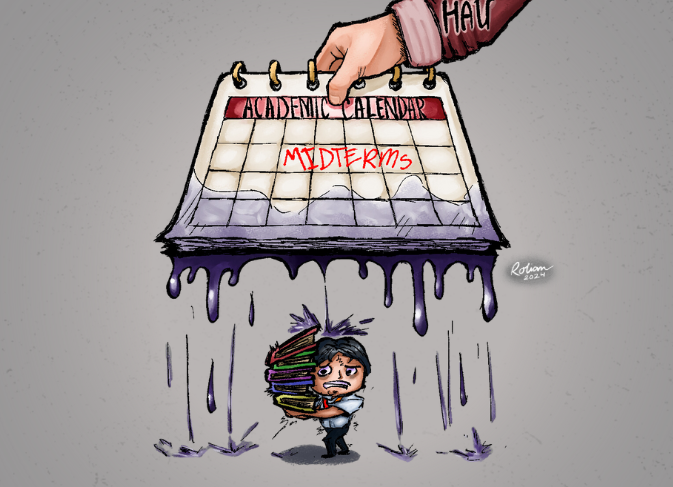
Unconscientious, incompetent, and uncompassionate—three words to describe the Holy Angel University (HAU) administration’s decision to proceed with the midterm examinations despite appeals from the student body to adjust its calendar in light of Tropical Storm Enteng’s onslaught.
In a not-so-surprising turn of events, the university has once again proven how out of touch it is with the reality faced by most students. As storms rage on, so does the administration’s indifference, raining inconsideration down on students who are left to fend for themselves amidst the chaos, all in the name of following an inconducive calendar.
During the first week of September, Tropical Storm Enteng wreaked havoc across the country, affecting at least 2,061,726 individuals, according to the National Disaster Risk Reduction and Management Council (NDRRMC). Of these, 65,599 Kapampangans were impacted by flooding, as reported by Pampanga’s Provincial Social Welfare and Development Office (PSWDO).
Consequently, the Holy Angel University-University Student Council (HAU-USC) appealed to the administration for an extension of the midterm period until September 18 so Angelites would be able to cope with missed lessons due to consecutive class suspensions throughout September 2 to 7.
As supplemental material to their request, the HAU-USC revealed that at least 1,600 Angelites surveyed encountered weak, unstable, or fluctuating internet connections during the onslaught of Enteng.
In connection with these challenges, what’s even more alarming is that the survey revealed that 1,960 Angelites have admitted to not being properly equipped or prepared for the exams due to a lack of face-to-face instruction—yet nothing has been done or said to address these concerning figures.
But in true HAU fashion, the request for extension was denied. Instead of compassion, Angelites were met with the usual insensitivity and must now cram two weeks’ worth of lessons in just two days, all because of the administration’s insistence on reverting to the pre-pandemic June to March timeline at all costs.
While this intention to realign HAU’s timeframe calendar is understandable, the administration should also be reminded that an effective and competent timetable is one that’s flexible and properly accounts for contingencies, such as typhoons and storms.
For instance, the Central Luzon State University (CLSU) has just recently moved their term examinations from September 16-18 to a later week due to the consecutive suspension of face-to-face classes brought by the onslaught of Tropical Storm Enteng. Such action by a university as affected as HAU by the calamity demonstrates that it is possible to be sensitive to the current state of students by adjusting set calendars, especially when their quality of learning and preparedness are put at stake.
They also need to understand that the usual “leniency” of giving certain considerations during synchronous sessions to those disadvantaged by catastrophes is merely a temporary fix. It often serves to make the admins feel better about themselves by allowing them to do the bare minimum without providing long-term solutions for these recurring problems.
Furthermore, HAU has to know by now that online classes are only as effective as your internet connection and housing situations. Deans directing faculty members to record their online sessions and upload them on Canvas should not be seen as substitutes for actual classes but should be considered for what they truly are—mere options rather than conducive and holistic solutions.
After all, how are students supposed to access these online materials when the reason they missed the sessions in the first place was due to internet connectivity issues?
HAU’s repeated failure to address students’ appeals—stretching back to the prelim period and echoing issues raised as far back as last year—now becomes a glaring hypocrisy to its rallying cry that “no students are left behind” and further makes its 3Cs of “conscience, competence, and compassion” as nothing but hollow principles.
To truly uphold their mantras means taking immediate and substantial steps to being receptive to student concerns and, on the bottomline, being sensitive to their situations.
Hence, it is crucial for the university to move the exam schedules and implement effective measures to ensure that all students have equitable access to quality education.
Additionally, though the administration may still seek towards their goal of restoring the pre-pandemic schedule, its academic calendar should be revised to accommodate disruptions that affect the education of its studentry. This balance ensures minimal interference with the institution’s objectives while addressing unforeseen challenges that may arise during the academic year.
Until all of these problems are addressed by the administration, Angelites will eventually understand that to study at HAU means to learn how to live with a system that’s severely disconnected with the plight of the student body—so much so that it would rather subject its constituents to subpar learning conditions than adjust a calendar that only makes sense to those who can pay not to feel the rain.