From summits and awards to an autonomous status granted by the Commission on Higher Education (CHED), Holy Angel University (HAU) recently took center stage with their triumphs. Announcements of these are magnified loudly—especially with the university renewing its Commitment to Human Rights with the Commission on Human Rights (CHR).
Visibly meant to advance its core value of “societal responsibility,” this partnership, and its eventual attainment of a “Center for Human Rights Education” recognition, allows the university to ground itself as an institution that is centered on “promoting and upholding human rights principles.”
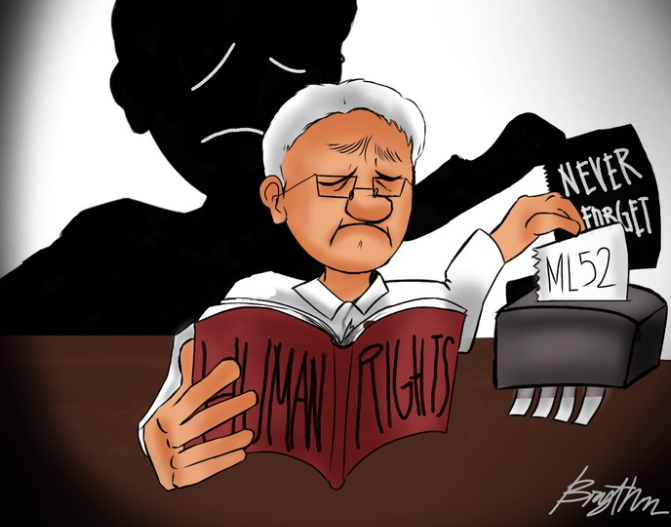
In blatant contrast to paraded human rights initiatives, however, the university’s unseen efforts to actually live up to its human rights causes, and the university’s silence towards a regime that violated the very core of human rights make the academic institution’s commitment to be nothing but hypocritical.
To contextualize, HAU signed its memorandum of agreement with the CHR on September 19, two days before martial law was declared by dictator Ferdinand Marcos Sr. 52 years ago. Parts of HAU and CHR’s collaboration are programs and initiatives including workshops, dialogues, training sessions, community extension, and research projects aimed to raise awareness, enhance understanding, and foster a culture of respect towards human rights among the Angelite community and beyond.
But in a stark contradiction to its human rights commitment, the university continues to be mum in the following days, with not even one acknowledgement over the human rights violations that took place in the Marcos dictatorship.
With the Philippines entering an era of darkness when martial law was first implemented by ousted dictator Marcos Sr., students, activists, journalists, politicians, and civilians were either brutally slain, imprisoned, or tortured for “disobeying” the government—a direct transgression of human rights.
In spite of this, HAU has not yet touched back in properly addressing the brutalities executed during the Marcos regime, despite it being a prime example of the grave importance of human rights.
Instead, student-leaders and student-journalists continue to be the sole bodies in a human rights-centered university who create projects, forums, and seminars exposing the injustices done by the Marcos family during the martial law and at present.
To publicly state that they are equipped to cultivate a generation of individuals knowledgeable of both human rights and their execution is a bold yet empty proclamation considering their blaring ignorance. Time after time again, HAU never fails to prove the irony of their actions towards urgent and critical issues—constantly standing still with nothing but indifference.
As a university that upholds the value of societal responsibility and regards societal justice highly in their work, human rights should never be a hindered nor redacted conversation. The core of these rights is to protect individuals from tyranny—hence, it is imperative that HAU should openly foster discussions confronting the violations of martial law towards human rights. The cruciality of human rights in real-life situations must not be singled out nor preferred.
Especially now, more than ever, than another Marcos holds the top post of the government and has, since then, distorted and revised history in an effort to whitewash his family’s name, academic institutions, like HAU, hold the responsibility of being centers of knowledge that educate their students and stakeholders of the truth about the former’s family’s atrocities.
When history is shunned, especially by an institution that tightly preserves its own, it is bound to be forgotten and buried—threatening to repeat itself. Thus, the people will never learn if history is not persisted in being remembered.