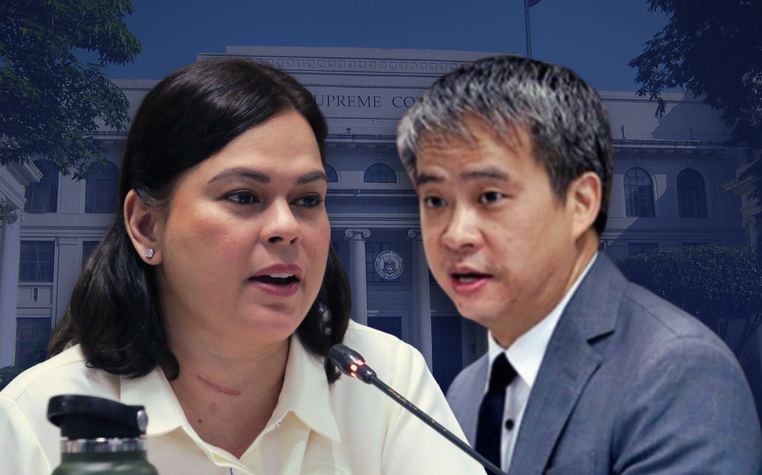
Despite the Supreme Court’s (SC) unanimous ruling declaring the impeachment articles against Vice President (VP) Sara Duterte unconstitutional, Senator Joel Villanueva said the Senate would still proceed with the trial, July 25.
“Whether the Supreme Court made that decision or not, the impeachment court will proceed. We’ll proceed,” said Senator Joel Villanueva, explaining that the Senate impeachment court is “sui generis,” a unique body that operates independently from standard judicial procedures.
Senator Bam Aquino echoed Villanueva’s stance, calling for an immediate meeting among senators to respond to the decision.
“As a co-equal branch, the constitutional mandate and power of the Senate are clear. The impeachment process should be respected,” Aquino said, adding that the High Court “ignored” the Senate’s constitutional duty.
Senator Vicente Sotto III agreed, citing a “legal luminary” who asserted that the Senate impeachment court could lawfully disregard the court’s decision — though he noted that legal counsel would still be sought.
Meanwhile, Senator Risa Hontiveros expressed confusion over the ruling. Referring to the Gutierrez v. House of Representatives case, she pointed out that the one-year bar rule pertains to timing, not the number of complaints.
She also criticized the SC for seemingly adding new requirements to the impeachment process.
“I can only hope that this new ruling will not adversely affect future efforts to hold our highest public officers accountable. The constitutional right of the people to hold their highest public officers accountable must always prevail,” Hontiveros expressed in a statement.
Akbayan Representative and human rights lawyer Chel Diokno also questioned the ruling, maintaining that the process followed the Constitution.
“The complaint was verified, endorsed by more than one-third of the House, at iisa lang ang kasong kinakaharap ni Vice President Sara Duterte. There was no violation of due process — only a demand to present the truth to the Filipino people,” Diokno shared on X.
Following this, Akbayan filed a Motion to Intervene, asking the SC to dismiss Duterte’s petition, which is “legally unsound.”
“The first three impeachment complaints filed were not referred to the Committee on Justice, thus, they do not qualify as initiated complaints. Only the fourth complaint qualifies as such. Therefore, lahat ng ginawa sa House ay ayon sa Rules of Impeachment na nakabatay sa Saligang Batas,” Akbayan Representative Perci Cañdena explained.
He also warned that a Duterte-favored ruling would weaken the constitutional role of the House in impeachment, stressing, “it would also show the general public that it has ‘monarchs’ rather than elected officials accountable to them.”
Additionally, Senator Francis “Kiko” Pangilinan questioned whether the SC would have reached the same decision had the Senate fulfilled its constitutional mandate and proceeded with the trial when the petition was first filed, particularly since the Court did not issue a restraining order at the time.
Meanwhile, Malacañang called for public respect toward the SC’s decision.
“The impeachment process is a matter handled by the legislative and judicial branches, and we recognize their independence in carrying out their constitutional mandates,” said Palace Press Officer Undersecretary Claire Castro.
In response, House Spokesperson Atty. Princess Abante acknowledged the ruling, but reiterated that impeachment initiation is the exclusive duty of the House. She warned that judicial interference “risks undermining the very principle of checks and balances.”
“Impeachment is a political act rooted in the people’s will — no legal technicality should silence it. The House will exhaust all remedies to protect the independence of the Congress and preserve the sanctity of our constitutional role. This is not defiance. This is constitutional fidelity,” Abante added.
SC spokesperson Camille Ting clarified that the ruling does not clear VP Duterte of the charges against her. However, any new impeachment complaints may only be filed starting February 6, 2026.
Senate’s Duterte bloc welcomes SC ruling
A known Duterte ally, Senator Ronald “Bato” Dela Rosa, attributed the Supreme Court’s recent decision to divine intervention, saying the justices were “guided by the Holy Spirit in defeating the forces of evil.”
“When I moved for the dismissal of the impeachment complaint vs VP Sara, I was guided by the Holy Spirit. When the SC ruled it as unconstitutional, I’m sure they were also guided by the Holy Spirit,” he said in a Facebook post.
Senator Alan Peter Cayetano, who previously moved to amend Dela Rosa’s motion to return the Articles of Impeachment to the House, expressed confusion on the reactions against the Court’s ruling, saying, “In the past, yung decision ng SC ilang beses na about impeachment tinanggap natin ‘yan eh, pati yung interpretation ng ano, yung once a year. So if this enriches our jurisprudence, and wala naman itong conflict sa mga nauna, nagtataka ako bakit may mga ganoong reaction.”
“We have to talk about everything in two contexts. One, nation-building. Number two, aligning kung anong gusto ng Panginoon sa ating bansa,” he further stressed.
Calling for a political ceasefire, Senator Imee Marcos called on her fellow senators, saying, “Sa mga kasamahan kong senador — trabaho na po tayo. Atupagin na natin ang kapakanan ng mamamayan. Awat muna sa pulitika!”
Meanwhile, Senator Juan Miguel “Migz” Zubiri warned that proceeding with the impeachment trial may hold the Senate in contempt, saying that ignoring the SC decision “endangers the delicate system of checks and balances that is foundational to our democracy.”
“Whether we agree with the decision or not, the Supreme Court remains as the final arbiter of constitutional issues — lest we destabilize the very framework of our government. Respect and honor the Supreme Court of the Republic. PERIOD,” he added.
SC declares VP Sara impeachment ‘unconstitutional’
To recall, the Supreme Court, in a unanimous 13–0 vote, ruled that the House impeachment complaint against Vice President Duterte violated the one-year bar rule, affirming that due process must be observed at all stages of the impeachment process. Citing Article XI, Section 3 of the 1987 Constitution, the Court emphasized that “no impeachment proceedings shall be initiated against the same official more than once within a year.”
The case stemmed from four impeachment complaints filed against Duterte. The first three were submitted to the House of Representatives on December 2, 4, and 19, 2024. On February 5, 2025, a fourth complaint — this time supported by more than one-third of House members — was transmitted directly to the Senate as formal Articles of Impeachment.
The SC ruled that the earlier complaints, having been “immediately transmitted to the Archives,” were considered “terminated or dismissed” as of February 5, 2025. Thus, the Court reasoned that the fourth complaint violated the one-year ban, which begins from the date of dismissal or termination. A new impeachment complaint may only be filed after February 6, 2026.
Prior to the Court’s ruling, the Senate had reportedly planned to begin the impeachment trial by August 4 — just a week after President Ferdinand “Bongbong” Marcos Jr.’s fourth State of the Nation Address — according to Senator Joel Villanueva in a July 16 interview.