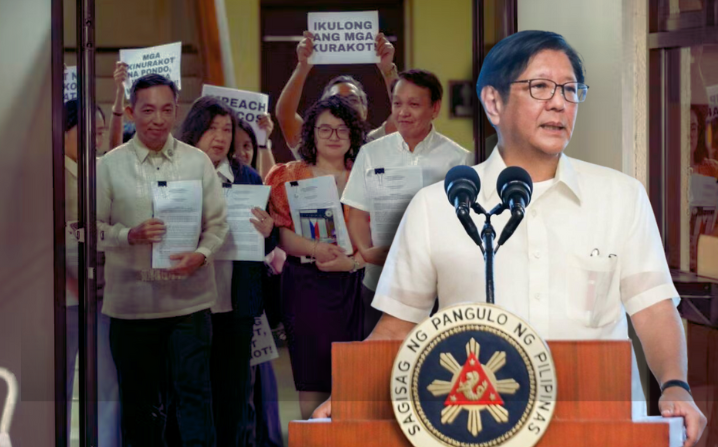
Two impeachment complaints against President Ferdinand “Bongbong” Marcos (PBBM) Jr., filed by lawyer Andre De Jesus and Makabayan bloc, were deemed “sufficient in form” by the House of Representatives’ Committee on Justice, February 2.
Tackled separately, Cagayan de Oro Rep. Rufus Rodriguez moved to declare the first impeachment filed by De Jesus as sufficient in form, but Manila Rep. Bienvenido Abante Jr. argued, prompting Committee Chairperson and Batangas Rep. Gerville Luistro to divide the House to vote.
“I did not properly hear the explanation on the sufficiency in form, and that is what I would like to hear, and because of this, I object,” said Abante, who later walked out after saying that the hearing is “an exercise in futility and a waste of the people’s money.”
The voting resulted with 46 in favor, one — which is Abante — against, and one abstention.
De Jesus’ complaint, filed January 19, consists of Marcos Jr.’s alleged violation of the Constitution and betrayal of public trust by allowing the International Criminal Court (ICC) to “kidnap” former President Rodgiro Duterte.
It also includes Marcos Jr.’s alleged drug addiction, failure to veto unprogrammed appropriations and other unconstitutional provisions of the General Appropriations Bill from 2023 to 2026, alleged kickback benefits, and the creation of the Independent Commission for Infrastracture to protect his corrupt allies.
Meanwhile, the second complaint, filed by the Makabayan bloc, was objected by Rodriguez as it lacked a notary public’s signature, but Luistro clarified that it was checked thoroughly.
The complaint was also put to a vote, with 35 in favor, nine against, and one abstention.
Filed on January 26, the Makabayan complaint focused on the “BBM Parametric Formula,” which allegedly became the “basis” on allocating infrastructure funds to lawmakers.
It also cited claims from fugitive Elizaldy Co that Marcos Jr., along with other Cabinet members, received kickbacks from anomalous projects.
Luistro explained that sufficiency in form refer to an impeachment complaint’s compliance to formal requirements such as the inclusion of the complainant’s proper signatures, verification based on personal knowledge and authentic records, and execution under oath.
“Tapos na, both complaints were declared sufficient in form. For tomorrow, we will be moving to the determination of sufficiency in substance,” she said, explaining that this is where the committee would assess whether the allegations, as pleaded, constitute impeachable offenses.
“The recital of facts must constitute the offense determinative of the jurisdiction of the Justice committee. Hindi po sapat na nakasaad dun yung mga pagkakamali. Ang tanong ito bang pagkakamaling ito, ito ho ba ay impeachable offense,” she added.
If either complaint would be found sufficient in substance, a resolution would be issued by the panel, directing the complainants to submit the necessary pleadings, after which hearings would be conducted, said committee vice chairperson and San Juan Rep. Ysabel Maria Zamora.
On the other hand, Malacañang said it will respect the process of impeachment.
“That’s the process; we have to respect that,” Palace Press Officer Undersecretary Claire Castro said, adding that Marcos Jr. knows that he has not committed any impeachable offenses.
The complaints, however, could negatively affect the country’s economy according to Castro.
“Nababahala po ang Pangulo sa impeachment complaint na isinampa sa kaniya hindi para sa sarili niya dahil alam niya na wala siyang ginawang mali at walang impeachable offenses siyang nagawa. Pero nag-aalala siya sa epekto nito sa ekonomiya,” she said.
Castro also cautioned on Makabayan’s “freedom of expression,” especially “lacking on evidence.”
“Madaling magbintang, madaling magsalita… Pero ang mahirap po rito ay patunayan ang kanilang pagbibintang,” she said.
With the complaints already found “sufficient in form” by the House Committee on Justice, at least one-third of all House members must now approve their referral to the Senate for an impeachment trial, as mandated by Section 3, Article XI of the 1987 Constitution.