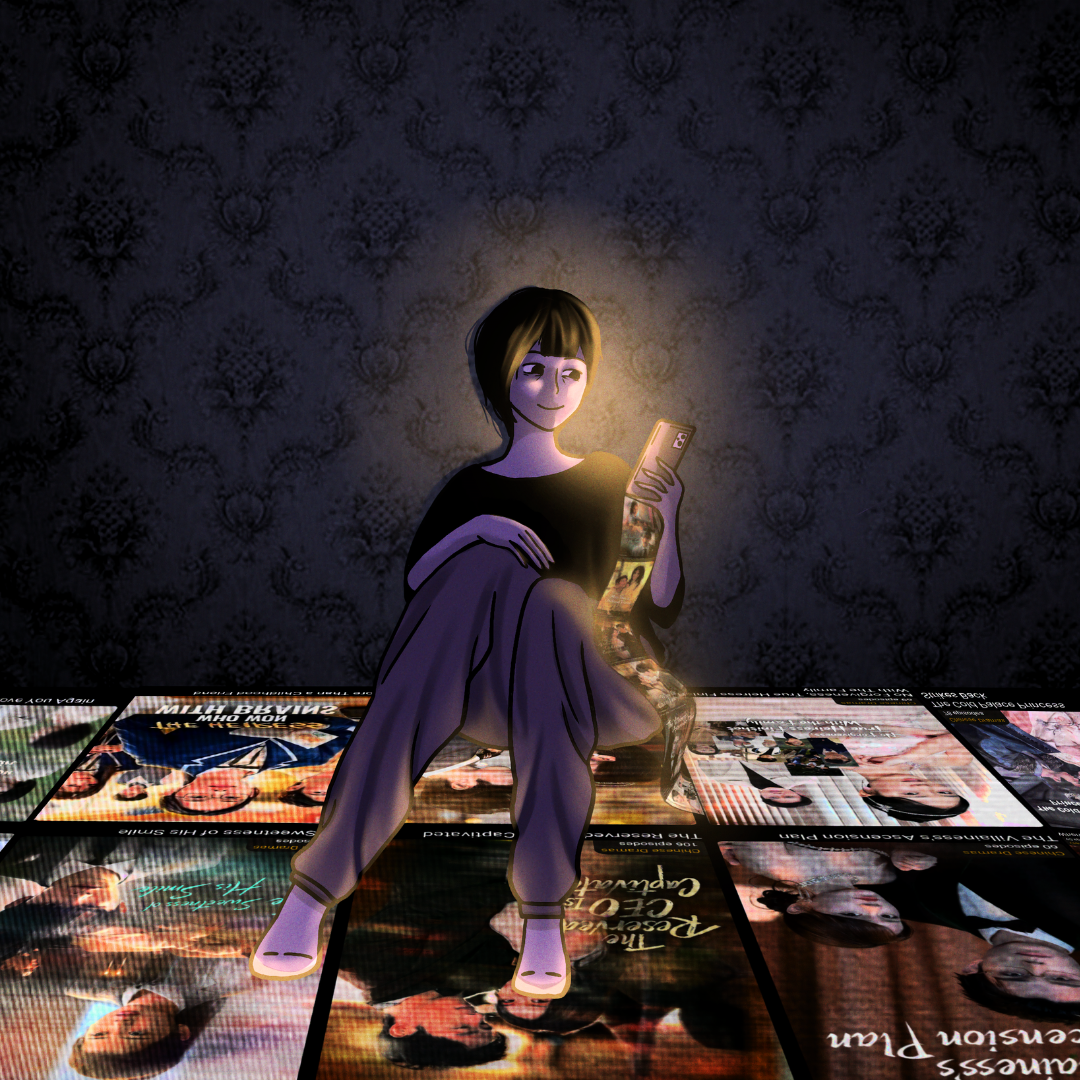
The screen goes dark just as someone is about to lose everything.
For a few seconds, there is only the cliffhanger — a crying face, an exposed secret, an antagonist finally cornered. Then the next episode begins.
It lasts less than three minutes.
For Ayre Miguel Liam Fabia, an incoming BS Computer Engineering student at De La Salle University (DLSU), this is how a breaktime can disappear: one episode becoming another, then another, until the story gives him a reason to keep scrolling.
He first encountered Chinese micro-dramas on TikTok, and what caught his attention was not necessarily originality, but the familiarity. The sense of already recognizing the shape of a conflict before it plays out.
“I guess what made them intriguing was the somewhat cliché plotlines with the exaggerated acting,” he shared. “Though some dramas that I have watched did have some unique plots that made them more interesting than the rest.”
That kind of encounter reflects a shift in where audiences find stories at all. Chinese micro-dramas are typically shot vertically, episodes under three minutes stretched across dozens of installments and built on typical tropes across genres.
According to People’s Daily Online, global downloads of Chinese micro-drama apps were projected to reach 1.21 billion in 2025, with overseas revenue expected to hit $2.38 billion.
Viewers no longer have to sit down and deliberately choose what to watch. A story can arrive in the middle of an ordinary day. That accessibility means entertainment can begin without a decision.
The comfort of knowing
Predictability is usually treated as a flaw in storytelling. For some viewers, however, knowing what kind of ending is coming is exactly what makes a story worth watching.
Fabia knows the pattern.
“It’s always the usual ‘the antagonist thinking they have achieved victory then the convenient plot twist happens which results in their eventual defeat,’” Fabia said. “I feel like what makes it entertaining is the satisfaction of seeing the annoying antagonist, who did nothing but be insufferable, finally be defeated and put in their place.”
Claire Adone Dizon, a first-year student at Angeles University Foundation (AUF), finds a similar comfort. She gravitates toward fantasy micro-dramas because their familiar premises still leave space to surprise her.
“I think it’s more interesting for me yung stories na parang alam mo na yung general idea, but it has enough na difference para hindi siya feel na copy paste lang ng ibang stories,” she shared.
Knowing the general direction of a story — even through spoilers she seeks out on purpose — is its own relief.
“Siguro yung recycling of familiar tropes gives me that sense of comfort kasi I already have an idea of where the story is going, so I know what kind of outcome to expect and I can still enjoy it.”
For a few minutes, the uncertainty belongs to the characters instead of the viewer. Their problems can be complicated, but the outcome never really is. That kind of certainty can be especially appealing when real life does not offer the same guarantee.
Foreign, but familiar
The worlds of Chinese micro-dramas may be foreign, but their conflicts often are not.
Family obligations. Financial hardship. Respect for elders. The desire to be recognized after being underestimated.
Lancewell Jehris Carreon, a second-year BA Communication student, saw it clearly in a story about a man who wakes up as a child again, racing to steer his father away from mistakes that once ruined them both.
“The setting is foreign, but the impulse is not,” he said.
What Carreon recognizes is not the setting, but the reason behind the character’s actions.
“Aside from family, I can recognize the Filipino value of respect for elders, especially in how characters listen to and honor older people,” he said. “I also notice perseverance, as characters continue working hard despite financial problems, failures, or difficult situations.”
Dizon sees similar patterns in local media such as teleseryes, films, and online fiction.
“A lot of the stories in Chinese micro-dramas feel familiar naman to Filipino viewers,” she said. “We also have a lot of movies, teleseryes, and online fiction that use similar tropes, like kunyari family conflicts, revenge, love stories, rags to riches plots, or yung mga characters na minamaliit and eventually nagiging successful.”
Aeon Rose Bañares, a Grade 11 student at Montessori de Sagrada Familia (MDSF), describes that same pull through the emotional connection she finds in stories that come from outside her own culture.
“I believe that these micro-dramas, even though produced with a foreign tongue, can still send a universal message to the world, especially when it comes to issues concerning even within our country,” she shared.
What she recognizes onscreen — corruption, discrimination, and neglect to name a few — she recognizes elsewhere too.
“They would feel seen if its intent is to be a type of comfort for them, like a warm hug,” Bañares added.
The algorithm finds the bored
But viewers do not always choose these stories. Sometimes, the story chooses them first.
For Christian Jacob Gonzales, a first-year BS Accountancy student, it began with a Facebook Reel advertisement.
“I remember a Facebook ad, and the way the ad was like made extremely good and it made me download the app where it exclusively was on, the way the ad caught my attention and curiosity made it worthwhile,” he shared.
He also noted that the effectiveness of these ads lies in their ability to “bringing the urge to continue watching if I get interesting or curious,” especially when the story is cut at a critical moment.
“I can’t stop thinking about it until I get to watch what happens next.”
Gonzales’ experience reflects a larger shift in how short-form audiences encounter entertainment. A 2024 study published in the Proceedings of the CHI Conference on Human Factors in Computing Systems analyzed 9.2 million TikTok recommendations across 347 users and found that users’ daily time on the platform increased over their time using it.
The algorithm may create the first encounter, but the reason viewers stay is more personal — an unfinished story gives them something immediate to focus on, and its resolution offers the small satisfaction of watching a problem actually end.
A break that fits
Not every viewer is chasing a cliffhanger. For Altair Carlos, a BS Psychology student, micro-dramas simply fit the gaps of an already full day.
“What makes fast-paced storytelling appealing to me is that you don’t need to sacrifice valuable time to keep up with the plot,” he said. “Additionally, this lets you watch them while doing chores or errands.”
That convenience matters because the need for escape does not always come with hours to spare. Micro-dramas allow viewers to step away from their own responsibilities without having to completely disconnect from their routine.
“Unlike other series with hour-long episodes, micro dramas require a lot less attention span to catch up when left and can be easily recapped due to the short duration of their episodes,” Carlos said.
“Watching these micro-dramas made me realise that good stories don’t have to be written in long chapters, just like how genuine connections can be built in a small amount of time,” he added.
For Bañares, that escape can carry a deeper emotional weight. She sees entertainment as something people turn to when reality becomes difficult.
“Entertainment is something we find solace in when we are unhappy with our real lives. It’s an escape through a form of art,” she said.
“Most definitely every one has a favorite show they watch when they want to disappear into their own realities. There is nothing wrong with liking such things, as it can be a source of healing for the viewer when touching subjects that hit close to home.”
In that sense, micro-dramas are not only convenient because they are short. They become meaningful because, for a few minutes, the problems belong to someone else — and the viewer can simply watch.
Somewhere else for a while
The appeal of micro-dramas lies in a contradiction: viewers looking for a quick escape keep finding comfort in stories that are familiar, repetitive, and almost formulaic.
Fabia gets his satisfaction from watching the antagonist finally lose. Carlos gets a break sized to whatever time is left in his day. Bañares sees entertainment as a form of solace.
None of them are watching because the stories are simply easy. They return because these stories keep a promise that reality rarely does.
The stories work in these Chinese micro-dramas because they offer something ordinary life often withholds: a problem that will eventually be resolved, a wrong that will eventually be corrected, a character who will eventually be seen.
For a few minutes, the viewer does not have to wonder how things will turn out.
They already know there will be another episode.
And so the screen goes dark again.
The thumb waits.
Then it swipes.