From red to violet, Pride celebrations across the Philippines continue to march on vibrant paths, creating space for the lesbian, gay, bisexual, transgender, queer, intersex, and asexual (LGBTQIA+) community to live and love freely, as seen in the estimated 228,000 attendees gathered in #OnePridePH’s simultaneous events nationwide in 2024.
A number that not only echoes the rising voice of the community, but also stands as a tribute to the first Filipino queers who sparked the first flicker of pride even in their darkest moments.
30 years ago, a small group of Filipinos gathered in the streets of Quezon City — not for a parade, but for a protest against the state neglect and discrimination that queer people had long endured.
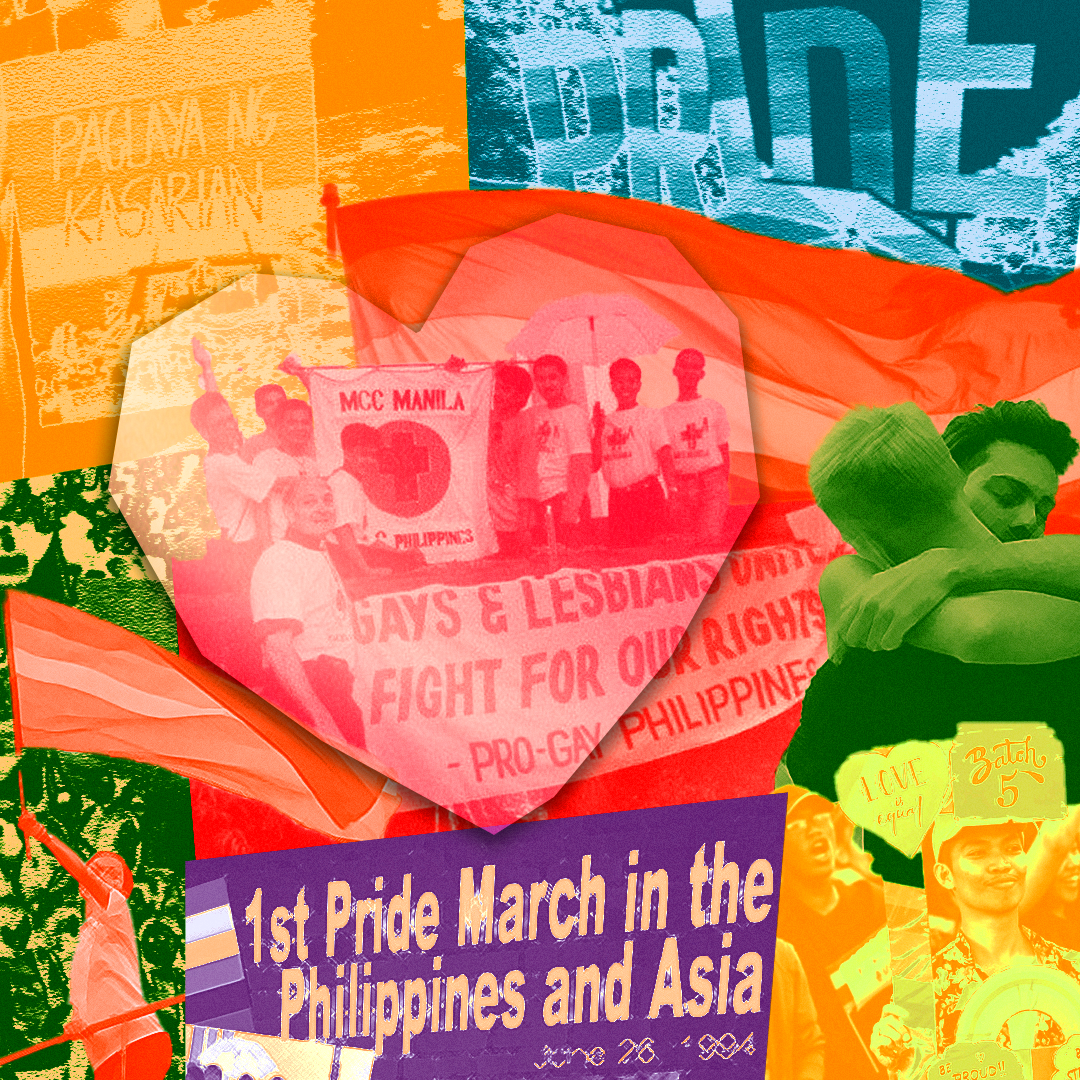
Clad in plain white shirts while holding banners that read “Fight for our Rights,” they marched under the sun, facing the stares and the silence of a country not ready to listen.
At the time, being openly queer came with real danger. Public ridicule, media demonization, and threats of police harassment were constant. Sodomy and vagrancy laws were still used to justify arrests, and most queer individuals risked losing jobs, homes, and family if they dared to live for who they are. Visibility meant vulnerability — and for many, staying silent felt like the only way to survive.
Yet the first Filipino pride march — later known as Stonewall Manila — stood tall as a bold declaration: they exist, and they deserve to be heard. They carved out space for conversations that had not yet reached the mainstream, expanding the horizons for the LGBTQIA+ community into the spotlight of the nation.
From just a few dozen in 1994 to hundreds of thousands in 2024, the LGBTQIA+ community in the Philippines continues to push forward, as rainbow flags wave in our streets each June. The movement continues to blaze with courage, camaraderie, and conviction — despite the oppressive forces that persists.
Because even after three decades, the same questions remain: With the SOGIE Equality Bill still stuck in Congress, with hate crimes and online abuse growing, and with corporations quick to pinkwash Pride but slow to defend queer rights — how far have we truly come, and how much farther must we march?
Many firsts of Pride
Before Pride took to the streets, moments of presence were already felt within other movements. In 1992, The Lesbian Collective (TLC) made a bold move by joining the International Women’s Day march in Manila — an event meant to celebrate all women. Yet, for TLC, the fight was twofold: not just for gender rights, but for visibility that often sidelined their voices on feminist discourse.
“At the time, it was still difficult even among women to say the word ‘lesbian,’ even though we were all holding a big banner proclaiming ourselves as The Lesbian Collective,” Giney Villar recalled on Lesbian Pride Stories, an event commemorating their march.
As other groups marched under banners calling to dismantle imperialism and address broader women’s issues, TLC had to carve out space — sometimes literally — to be seen and heard.
Their presence was not always welcomed; some fellow marchers kept their distance. Even so, the group stood firm as they demanded that lesbian rights be recognized alongside other feminist concerns; they became among the first in the LGBTQIA+ Filipino community to assert that their presence and rights deserve equal weight.
The following year, University of the Philippines (UP) Babaylan, the first LGBTQIA+ student organization in the Philippines, stepped into the spotlight for the first time at a Lantern Parade in Diliman, boldly chanting: Out of the closets, into the streets!
As they marched, some pockets of the crowd met them with jeers, but many more responded with support. Since then, Babaylan’s presence in UP Diliman’s Lantern Parade has become an enduring tradition.
On June 26, 1994, the ProGay Philippines and the Metropolitan Community Church launched a protest which later became a historic turning point for queer Filipinos known as Stonewall Manila. Held in commemoration of the 25th anniversary of the Stonewall Riots, a series of riots and demonstrations between gay activists and the police on June 28, 1969 in New York, it also made history: the Philippines became the first country in Asia and the Pacific to host a Pride-related march.
One of the organizers, Edgardo Tolosa, revealed the atmosphere of fear and resistance that defined their march — a time when simply demanding dignity meant risking liberty.
“Sa kabila ng banta at pananakot ng PNP (Philippine National Police) na huhulihin ang mga lalahok sa kilos protesta, magiting na nagmartsa mula Quezon Avenue patungong Quezon Memorial Circle ang mga LGBT upang ipaglaban ang karapatan bilang bakla at tomboy,” Tolosa stated on a Facebook post in 2020.
He further shared that their inspiration was not about being seen, but about fighting for everyday concerns Filipinos face such as the Value Added Tax (VAT). This led some to question whether the 1994 protest could truly be called a Pride March, or moreso, the very first, as it unfolded alongside a larger demonstration against the broader concerns.
But that very tension reveals how Pride has taken shape in our country — not always loud or colorful, but always political. As time passes, people acknowledge this event as the country’s first ever Pride March, because it dared to link queerness with protest.
But for two years, the chants echoed only in private gatherings and whispered meetups. There were no banners lining the streets, no chants bouncing off buildings that fought for gay or lesbian rights, no follow-up march.
Yet, something shifted in 1996. On that humid June morning, hundreds gathered in what they call “Solidarity ‘96.” That gathering was not a protest of tax reforms or to piggyback on another cause. This time, it was about them. The chants, the signs, the laughter — it was unmistakably queer, loud, and united.
Jomar Fleras, a managing director from ReachOut AIDS Foundation, described the event as “not going to be a very activist march but more of a celebration of diversity and gay and lesbian solidarity.”
Still, the march did not shy away from raising issues like discrimination and harassment. More than anything, it marked a historic first: the country’s — and Southeast Asia’s — first joint march of queer communities.
For many, this was the country’s first true Pride event. It was a time when the Filipino LGBTQ+ community marched not just in protest, but in unity. They held each other’s hands like lifelines, bound by a shared voice and purpose.
This prompts us to ask: How do we define Pride? Is it about being seen? A fight for love? A community? Or about standing up for the lives we live every day? In this country, the answer has always been all of the above.
In the years that followed, new LGBTQ+ groups began to rise, each one carrying stories and strength to the growing fight for equality.
By 1998, whispers from the streets reached the chambers of power. Activists who once marched with handmade placards were now speaking in policy briefings. Akbayan, a progressive party, was the first to truly listen — not out of charity for the community, but solidarity.
Then in 1999, a coalition called Lesbian and Gay Legislative Advocacy Network (LAGABLAB) was born. A year later, they filed the Anti-Discrimination Bill, marking a step in the legal aspects. It was a demand of protection under law, a move for queer stories to no longer be confined in back rooms or hidden diaries.
Slowly, the spirit of pride was no longer just found on the streets.
More than just a parade of colors
Fast forward to the 21st century — Pride marches in the Philippines no longer resemble the cautious, defiant steps of their early years. What once began as a lone picket in a crowded street has blossomed into city-wide festivals that pulses through music, art, and collective joy.
Across cities and provinces, what began as isolated acts of defiance have transformed into yearly rituals of resistance and identity. But the celebration has never replaced its purpose, nor have the protest marches ever truly stopped — they come up with themes for their advocacies especially in a climate where legal protections remain out of reach and discrimination persists.
Pride may burst with creativity, but it continues to confront a society, and a system that still debates queer existence.
In a country where this persists, to declare same-sex love publicly was seen as a radical act. Queer relationships were often reduced to punchlines or hidden entirely. But in 2014, the Metro Manila Pride March carried “Come Out for Love, kasi Pag-ibig Pa Rin,” a message that marked the movement to its emotional core.
It was a march held in culmination of a campaign launched by Task Force Pride (TFP), which aimed to pare down the LGBTQIA+ movement to its very essence. Marchers carried rainbow flags and props, some holding signs that read, “Love knows no gender.”
“In the end, we want to send the message that the core of the LGBT advocacy is love,” said TFP spokesperson Nicky Castillo.
“LGBT people, their friends, their families, and their supporters came out to march to assert that we are here for each other, calling for the recognition of our right to love, our freedom to love, and for the people we love,” Castillo added, noting that the march brought together not only queer Filipinos but also their non-queer allies.
A year after the first love campaign, the Pride movement raised its voice even louder with “Fight for Love: Iba-iba, Sama-sama.” It was a call for equal treatment under the legalization of same-sex marriage. But on the ground, there was a mix of hope and hard truth.
“We don’t even have an anti-discrimination law, which I think is what we should focus [on] first,” said Paulo Castro, who joined the 2015 march with his boyfriend. Like many others, he believed that while love was worth fighting for, legal protection had to come first.
In 2016, Pride carried the theme “Let Love In: Kahit Kanino, Kahit Kailan,” culminating the love-centered campaign. Around 4,000 people joined the march in Marikina, making it one of the largest at the time.
One group that captured hearts that day was the Home for the Golden Gays (HGG). Dressed in colorful wigs and sparkling gowns with bright make-up, the lolas of HGG posed for photos and waved to the crowd.
“A gay is a gay,” said Cesario De Guzman, a Kapampangan lola from HGG.
“Before, there weren’t events like this. I hope the youth look up to us — we really try to be good role models,” De Guzman stated as she highlighted how cross-dressing was largely frowned upon and often relegated to confined places like gay bars.
The following year, over 7,000 people gathered under the banner “Here Together,” a theme rooted in the growing need for solidarity within the community.
“If you notice, there’s a national progression for the kind of action or the kind of impact that we want the Pride campaign to have on the community,” said Loreen Ordono, noting how the 2017 theme marked a shift from the previous three years, toward a broader call for collective action.
The theme of solidarity continued in 2018 as “Rise Up Together” drew more than 20,000 attendees. The crowd grew so much in size, marching even louder as they demand recognition for gender rights and same-sex marriage.
Castillo said the event aimed to empower communities to push for pro-LGBTQ+ policies and advocate for social justice, with the goal of helping more people become “better activists, allies, and advocates for the community.”
Then came a historic leap in 2019. With the theme “Resist Together” as the rallying cry, at least 70,000 marched through the streets — thrice as much as the previous year. The crowd pulsed with rage and resolve, banners raised high against a state of hostility.
At the time, then-President Rodrigo Duterte had made discriminatory remarks, who infamously claimed he had “cured” himself of homosexuality and has repeatedly weaponized gay slurs in public speeches. For many, his words were not just insults; they were signals of a government that saw queer lives as jokes, illnesses, or threats.
“He’s absolutely wrong on that one. That’s not how it works!” said marcher Noel Bordador. Still, Bordador emphasized the real fight ran deeper than the president’s outrageous claims.
“Can I get married here? Do I have rights?” he asked. “Legal protections — that is what we are fighting for.”
Another historic moment unfolded when the COVID-19 pandemic forced pride marches to lean on digital means in 2020. Yet, the movement never went silent.
“We may not fill the streets but we will still be as loud and as proud in as many digital channels as possible,” declared Metro Manila Pride.
Even in isolation, Pride found its way from the streets to screens. The organizers launched a collective digital Pride through live-streamed events like quizzes and queer arts nights, alongside hangout discussions and community meetings tackling urgent issues faced by the queer community.
By 2021, the community began cautiously reclaiming physical space. Bahaghari PH and Metro Manila Pride held a short but powerful march called “Sulong, Vaklash!,” a fierce assertion of queer presence in the midst of state neglect and violence.
Addressing the crowd, Bayan Muna Representative Eufemia Cullamat condemned “state-sponsored violence” against LGBTQ+ Filipinos, citing the early release of the U.S. soldier who murdered Jennifer Laude and the military killing of lesbian activist Lenie Rivas.
Salinas, a transwoman, also stood firm against the Duterte administration after they, along with 19 others, were detained for organizing a Pride protest in 2020.
“Ang martsang ito ay ‘di lang selebrasyon, protesta ito… Tuloy ang pagpapahirap sa sangkabaklaan dahil sa kapalpakan ni Duterte sa pagtugon sa pandemya,” they said, urging continued resistance.
For her, neither the pandemic nor police threats should silence the movement.
“Marami pa ang kailangang ipaglaban at pagtagumpayan,” they added.
That year’s Pride ended with what many described as a “verdict” against the Duterte administration’s brand of machismo and impunity.
By 2022, in-person Pride celebrations made a stronger comeback. “Alab for Love,” held at the Quezon City Memorial Circle, was one of the many marches that reignited the tamed flame. Metro Manila’s own “#AtinAngKulayaan: Makibeki Ngayon, Atin ang Panahon!” joined in, alongside regional parades in Baguio, Iloilo, Romblon, Mindanao, and Tacloban, among others.
Then in 2023, another milestone in the history of pride in the Philippines was made. Over 110,000 gathered for the Pride PH Festival in Quezon City, dubbed as the “Largest Pride March in Southeast Asia” at the time.
With “Love Laban” as its call, pride became a collective pushback against years of delay amid government inaction on the Sexual Orientation, Gender Identity, and Gender Expression (SOGIE) Equality Bill. In a country that still discriminates against a feeling meant for all forms and ways, queer love still has to be fought for. Its ironic theme lay in how something as tender as love had to be shouted through megaphones and carried on banners under the heat of protest.
Quezon City Mayor Joy Belmonte emphasized that the event was “not because this sector is seeking special treatment,” but because LGBTQIA+ Filipinos “long for a halt to the undeserved ill treatment and denial of opportunities they continue to suffer from” a truth many in the crowd knew all too well.
That same event also introduced the Right to Care Card which allowed LGBTQ+ couples to make medical decisions for one another, strengthening queer families. In 2024, the number surged again, this time to a record-breaking 200,000, taking the historical title.
And this year? The numbers are expected to rise even higher. Because every June, the call for equality grows louder, and the fight for dignity becomes more urgent.
While many of these Pride marches still begin and end in Manila, the spirit is spreading. But from Luzon to Mindanao, the demand remains the same: to make the system right, because queer rights are basic human rights.
Across the country
The vibrant celebrations of pride does not merely lay at the heart of the Philippines, but stretches across the different parts of the country.
Outside Metro Manila, queer communities and their allies continue to create their own versions of visibility — sometimes bolder, sometimes riskier.
In Pampanga, Pride festivals have also begun to take form, starting with “Pinanari: A Stride for Equality!” last 2024 at the CDC Parade Grounds. Spearheaded by Junior Chamber International (JCI) Angeles City-Culiat, the event is currently set to take on this year’s iteration on June 21 at the Nepo Center in Angeles City, featuring parade, concert, and food stalls in collaboration with Pampanga Taste Fest.
Even Kapampangan student-led movements are growing. Last year, Holy Angel University – University Student Council (HAU-USC) launched its first-ever Inclusivity Walk, with another being awaited by the end of this month — a proof that young voices are adding momentum to the cause.
Up north, Surftown Pride returns to La Union with the theme “#MakiAgos,” spotlighting emerging queer subcultures through talks, performances, and a Pride parade across the province’s key surf spots.
Baguio City also held its first-ever Pride Expo, led by the local government and LGBTQIA+ groups. With booths, games, speed dating, film screenings, open mics, drag shows, and panel talks, it carved out creative spaces for queer expression and community.
Meanwhile, Cebu carries on its vibrant Pride legacy with its first-ever Pride Picnic on June 29 — an open, community gathering that honors both their joys and struggles.
Yet not all Pride events are held with the same freedom. In Davao, the 2024 Pride March came with notable restrictions: chanting of foul language and anti-government expressions was explicitly prohibited.
Event organizer Harold Quibete stated that the parade was aligned with the city’s “Disiplinado” slogan, and followed standardized guidelines used in all public gatherings. Branded as part of the Duaw Davao 2024 tourism campaign, the event leaned toward celebration, but one carefully curated to maintain order.
This contrast in regions reveals the fragile line queer communities must walk in our country — between being seen and being silenced, between celebration that is allowed and resistance that is punished.
Marching continues
“Are you gay?”
“Do your parents know?”
“So, who’s the guy in the relationship?”
These are just a few of the many questions queer Filipinos hear throughout their lives — asked in classrooms, at family dinners, in whispered gossip, and loud judgements. Answering them, if one chooses to, still takes courage.
Today, conversations about identity are more open, visible, and vital than ever. But coming out is never a one-time act, and it’s not always met with acceptance. It still takes a lot of strength and courage to name oneself in a world that can be unkind.
That’s why Pride matters. It has grown beyond marches. Every June, the Philippines comes alive with its energy — and not just in parades. It blooms across stages, canvases, lecture halls, cafés, and screens — places that we don’t often see
Despite growing turnout and attendance each year, the same cry for equality remains. First filed in 2000, the SOGIE Equality Bill — meant to protect Filipinos from discrimination based on sexual orientation, gender identity, and expression — has been refiled across multiple administrations. It passed the House in 2017. But by 2019, it became the longest-running bill under interpellation in Senate history — stuck once again.
Its progress is repeatedly derailed by the country’s deeply rooted Catholic and conservative values. Legislators aligned with these views, particularly in the Senate, have repeatedly chosen inaction. The 19th Congress had every chance to act — and yet, it did not.
Opponents of the bill — including Sen. Joel Villanueva and his father, religious leader and CIBAC party-list Rep. Eddie Villanueva — argue that its passage would create “special rights” for LGBTQIA+ people and threaten “social order.” These narratives frame equality as excess and protection as danger.
While weaponizing morality and tradition against those already marginalized, they distort the bill’s true intent which is to ensure safety and dignity for all.
And when the law fails to protect, violence finds cover.
In April 2024, that marginalization became glaringly apparent when Taylor Sheesh, one of the most well-known drag performers in the country, was assaulted during a town concert in Bayambang, Pangasinan. As she performed, a male audience member was seen on camera striking her in the neck; the video swiftly went viral and sparked public outrage.
“This is traumatic. Literally. I’m shaking right now,” Sheesh, whose real name is Mac Coronel, wrote on X the following day.
For queer Filipinos watching, the incident was a chilling reminder that even the most beloved queer icons are not safe in public — a truth made more brutal by the continued denial of legal protection. And while the SOGIE bill remains absent, we must ask: who continues to benefit, while the visible and vulnerable keep paying the price?
While progress has come in pockets — over 20 local government units have passed gender-fair ordinances — implementation remains patchy. Only a few cities, like Quezon City and Cebu City, have built systems to enforce these laws. For most, protection remains a promise, not a reality.
In 2019, the municipality of M’lang in Cotabato criminalized same-sex relations and cross-dressing among Muslims — setting a dangerous precedent.
A year later, during the height of the pandemic, twenty protesters — 13 of whom were queer — were arrested after marching to Mendiola to celebrate Pride and denounce the Anti-Terror Law.
Among them was Bahaghari spokesperson Rey Valmores-Salinas, who later declared, “There is nothing wrong with demanding equality… especially in a time when resistance to an oppressive government is needed most.”
Although they followed health protocols, they were charged with disobedience and illegal assembly. Police failed to cite any specific violations at the scene — only saying, “Nasa batas iyan na bawal iyan.”
Yet neither the Bayanihan To Heal As One Act nor the public health law, Republic Act No. 11332, actually prohibits rallies. Human rights advocates noted this was not the first time lockdown rules were weaponized to suppress LGBTQ+ voices.
The charges were eventually dismissed — a rare victory in a time of shrinking civic space. But the image of Pride 20 left a mark in the eyes of many. What was meant to silence them only amplified their cause.
And so, the community marches — again. Not because they want to, but because they have to. Because silence doesn’t bring change. Because love is still waiting for legal protection.
Filipino pride is layered like their very representation — rainbows. With different colors and purposes, they symbolize a lot of things: celebration, remembrance, and resistance.
It honors those who paved the way, even as it pushes forward for those who still face rejection, violence, or invisibility. It carries with it the stories of those who cannot come out, those who have been disowned, those who dream of simply existing without fear.
But the dream of the community is not just to be seen, but to be safeguarded. Not just to be allowed to love, but to be protected in that love.
If change takes root, maybe the streets would not need to carry our cries. That queer Filipinos can hold hands without bracing for backlash, love without fear, and live without needing to prove their right to exist. That rainbow flag would no longer have to defy, but simply belong.
That Pride will no longer be a protest but a parade of love — celebrated, not just tolerated.
Until that day comes, we march as the streets remain our witness. We march because silence still kills, because the law still lags, because too many are still forced to hide.
And the question is no longer whether Pride will march — but whether the nation is finally brave enough to walk beside it.