Commuters are set to pay higher jeepney fares starting March 19 after the Land Transportation Franchising and Regulatory Board (LTFRB) and the Department of Transportation (DOTr) approved a provisional fare increase across several public utility vehicles (PUVs).
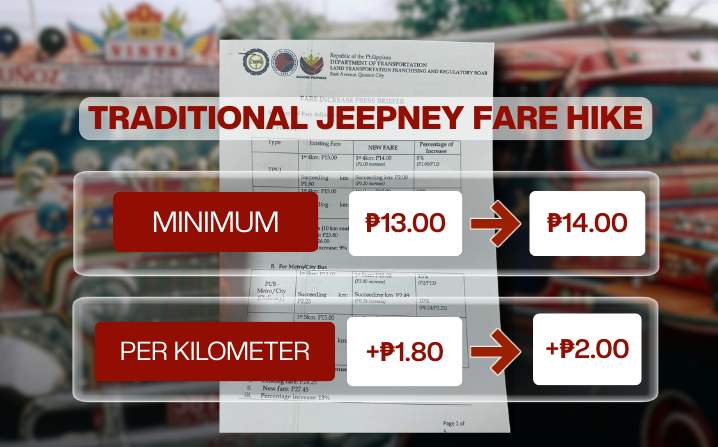
Under the new fare matrix, traditional public utility jeepneys (TPUJs) will raise their minimum fare from P13.00 to P14.00 for the first four kilometers, with the per-kilometer rate for succeeding distances increasing from P1.80 to P2.00.
Modern public utility jeepneys (MPUJs) on the other hand will charge P17.00 for the first four kilometers, previously P15.00, and P2.40 for each additional kilometer.
The adjustment was announced during a press briefing led by LTFRB Chairman Vigor D. Mendoza II, who also approved specific increases for buses, airport taxis, and transport network vehicle services (TNVS).
Specific fare hike details for UV Express, motorcycle taxis, and regular taxis are still pending.
Mendoza stated that the hike was prompted by rising global oil prices, which have been influenced by ongoing geopolitical tensions in the Middle East.
He added that it will continue to monitor fuel price movements and may implement further adjustments if necessary.
Moreover, LTFRB emphasized that the fare hike is aligned with the directive of President Ferdinand “Bongbong” Marcos Jr. and supported by the DOTr under Secretary Giovanni Z. Lopez, which aims to maintain a “safe, efficient, and fair” public transportation system while helping ease the burden on commuters.
In addition, LTFRB clarified that the new rates may still be changed and are expected to be finalized by June upon the release of updated fare matrices.
Earlier, transport group PISTON announced a nationwide strike on March 19 in protest of successive fuel price hikes.
“Ngayong darating po na March 19 ay idedeklara po natin at ilulunsad po natin, hindi lamang po sa National Capital Region kundi sa buong bansa,” PISTON national president Mody Floranda declared, March 16.
Floranda added that the group plans to push for a P5 fare increase, arguing that drivers continue to suffer income losses due to soaring fuel costs.
He also criticized the government’s P5,000 cash assistance for drivers and operators, saying it is insufficient and may only cover a few days’ worth of fuel.
The group further called on oil companies to release lower-cost fuel stocks before implementing price increases and urged the government to repeal the Oil Deregulation Law, which it claims allows firms to dictate fuel prices.
PISTON also called for the suspension of excise taxes on petroleum products.
Meanwhile, the Senate of the Philippines on March 17 approved Senate Bill No. 1982, giving Marcos Jr. authority to suspend or reduce these taxes when the average price based on the Mean of Platts Singapore exceeds USD 80 per barrel for a month.
However, in the House of Representatives of the Philippines, House Bill No. 8418 adds that a state of national emergency or calamity must be declared by the president before such action can take effect.