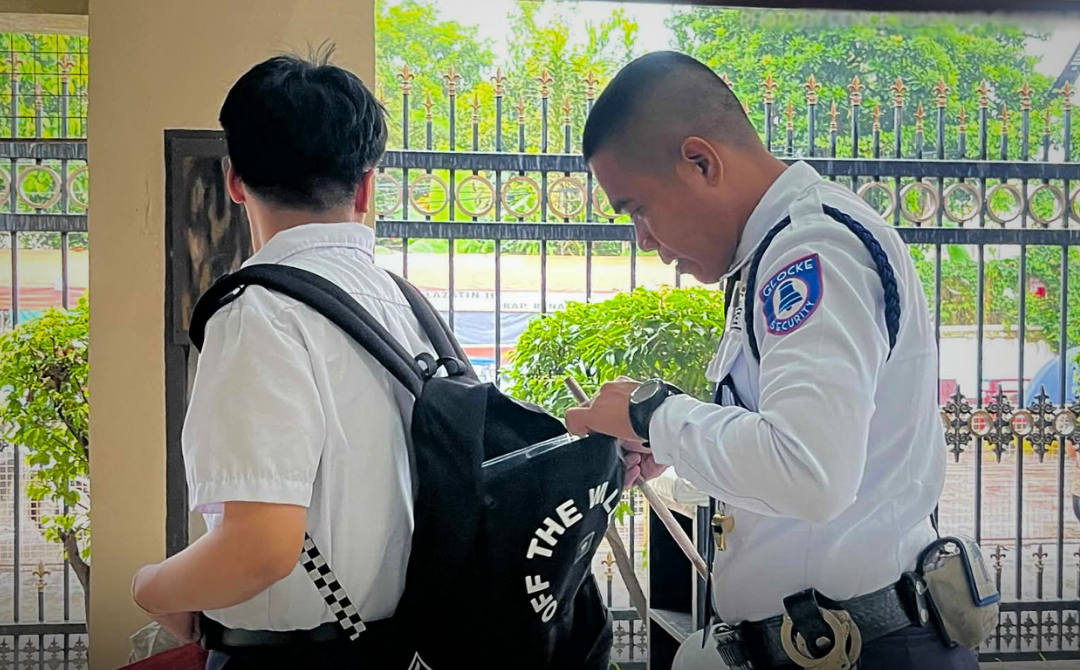
Office of Student Affairs (OSA) Safety and Discipline Coordinator Mr. Melvin Layon clarified that bag checks at the main gate on June 23 were not a reaction to recent concerns over school violence but were instead a surprise inspection.
However, Mr. Layon emphasized that the university is “taking the situation seriously” and is acting “proactively” to prevent the situation from happening.
“Baka nga may gagawin yung mga hindi natin alam, ‘no. Mas maganda i-secure yung mga estudyante, either wala pang nangyayari kasi mas maganda proactive yung ginagawa natin ngayon para ‘pag may mangyari, hindi na niya gagawin kasi advance na tayo mag-isip,” he explained.
By implementing these measures, Mr. Layon said that the university is staying ahead of potential offenders by discreetly inspecting bags and vehicles that could be used to bring in items harmful to students.
“So dito sa school, number one talaga yung safety and security ng estudyante ang aming pinoprotektahan kasi kayo yung pinaka-customer namin. Dapat kayo ay protektado sa loob ng eskwelahan,” he said.
Aside from these measures, an orientation will be conducted for class presidents following the class elections for each section.
He noted that OSA is better positioned to maintain communication with class presidents and the student council, as security and safety are not solely the responsibility of the Campus Services and Development Office (CSDO) or the OSA but of everyone.
“So ibig sabihin pag concern ka sa safety at sa security, may nakita kang mali o masama, ire-report mo agad. Hindi pwedeng ah bahala sila trabaho ng security guard, pero alam mo may maling ginawa, report mo na agad para hindi na gumawa ng masama,” he stated.
He said communication should be strengthened to ensure awareness among students, stressing that any incident or concern should be reported immediately so it can be acted upon promptly.
Successive fire alarms attributed to line fault
Meanwhile, Mr. Layon attributed the university’s multiple false fire alarms to an eighth-floor electrical fault line in the Peter G. Nepomuceno (PGN) building that caused a severe wiring fluctuation.
Mr. Layon explained that the alarm activation was attributed to a line fault and not to any manual operation of the activation point.
Based on their review, no evidence was found indicating that the device had been pressed. The alarm was reportedly triggered by a fault condition within the system.
“So as of now, para hindi naman ulit yung senaryong mag-alarm ulit, dini-deactivate muna namin para i-check muna ng parang third party, para i-check kung bakit lagi na lang nagti-trigger yung eighth floor ng fire alarm,” Mr. Layon said.
He further affirmed that the alarm line is being inspected, as it is the only area where issues have been observed.
He noted that the inspection aims to prevent false alarm activations that could lead to unnecessary evacuations and to ensure that any future alarm accurately reflects an actual emergency situation.
“Kasi alam natin na kapag nag-alarm na, lahat ng empleyado at saka estudyante, they take seriously to get out, go down, and proceed to the evacuation area,” he explained.
Such a response, according to Mr. Layon, demonstrated the effectiveness of regular fire and earthquake drills, which help people become “more aware” of emergency situations and react appropriately during actual disasters..
To mitigate the spread of false information, Mr. Layon shared that fire safety experts were called in to rectify the system glitch.
“So yung continuous dissemination emerge uh response namin, pumunta agad kami, chineck namin kung totoo, pero wala talaga siyang ano, wala siyang human error,” he concluded.