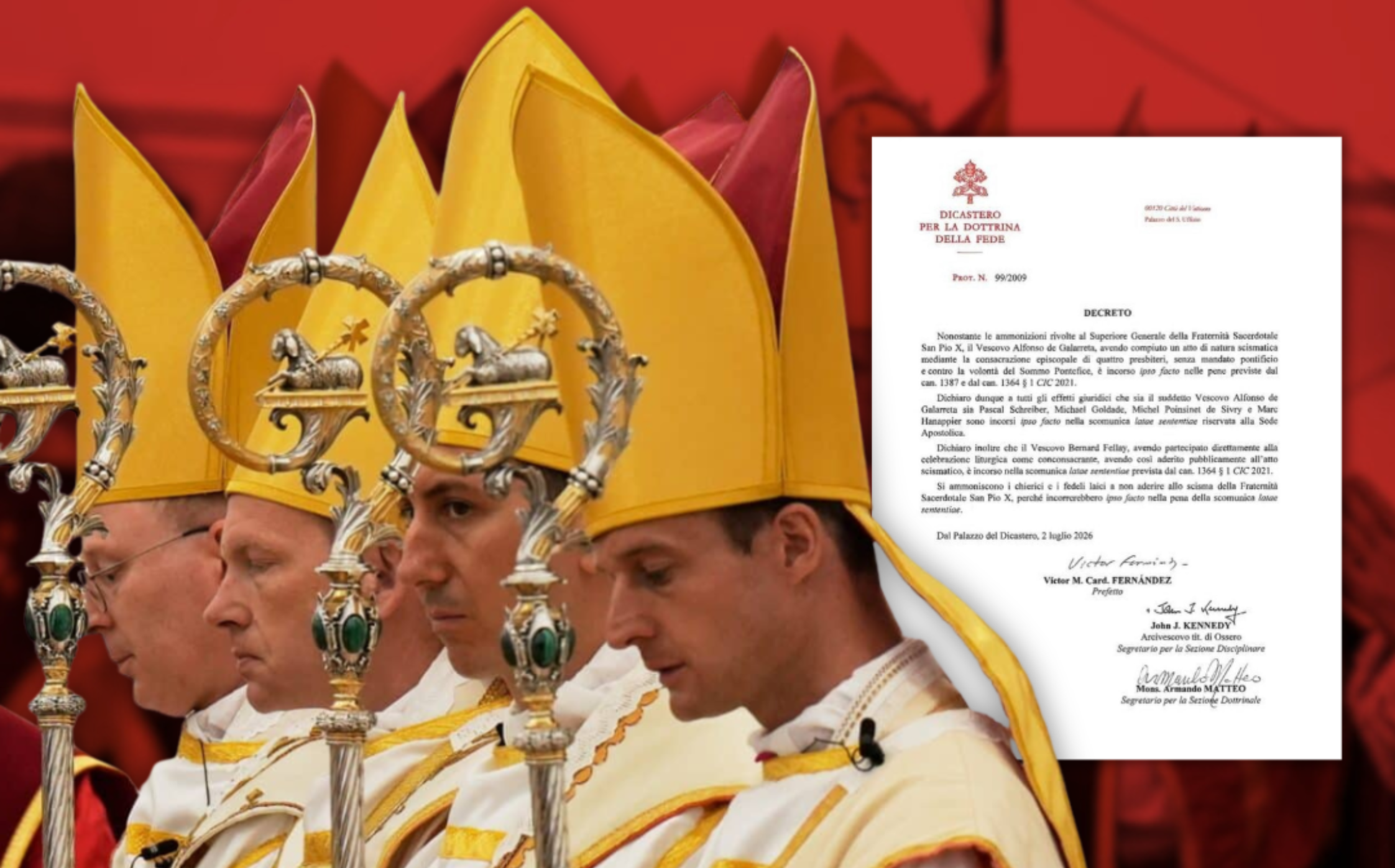
Following the unauthorized consecration of new bishops, the Vatican stated that all bishops involved incurred automatic excommunication, describing the ceremony as an “act of schism” that constitutes a grave and intentional rupture in communion with the Pope and the Catholic Church.
In a decree issued on July 2, the Vatican, through the Dicastery for the Doctrine of the Faith (DDF), said two bishops of the Society of Saint Pius X (SSPX) illicitly consecrated four new bishops without papal mandate.
They added that the SSPX leadership remains in a state of separation from the Church of Rome.
This administrative response came after the consecrations took place in Écône, Switzerland on July 1.
The guidelines, designed for return to full communion, explicitly outline a five-step protocol for clergy, including a written request to Pope Leo XIV.
Moreover, the Holy See through DDF clarified that lay Catholics attending SSPX chapels for the Traditional Latin Mass are not excommunicated, but they cannot validly receive confession or marriage.
According to the Church, any lay believers who “formally adhere” to the group would suffer the same fate.
Additionally, DDF has issued directives outlining separate procedures for traditionalist priests and laypeople seeking to rejoin the Catholic Church. The guidelines require individuals to profess acceptance of the teachings of the Second Vatican Council, which the traditionalist movement has historically rejected.
Citing Canons 1387 and 1364 of the Code of Canon Law, the Vatican said the bishops — Pascal Schreiber, Michael Goldade, Michel Poinsinet de Sivry, and Marc Hanappier, along with the two bishops who performed the consecrations — incurred latae sententiae excommunication by the act itself.
As a result, all six bishops are prohibited from exercising ecclesiastical ministry and remain under excommunication until the penalty is lifted by the competent Church authority following reconciliation.
The excommunicated bishops were then required to submit formal letters for the remission of censures and establishing coordination by papal nuncios as of July 3.
The SSPX, a traditionalist Catholic group, has long opposed reforms introduced by the Second Vatican Council in the 1960s, which reshaped modern Catholic liturgy and governance.
In 1988, the ultra-traditionalist breakaway group triggered a major rift with the Vatican after consecrating four bishops without papal approval.