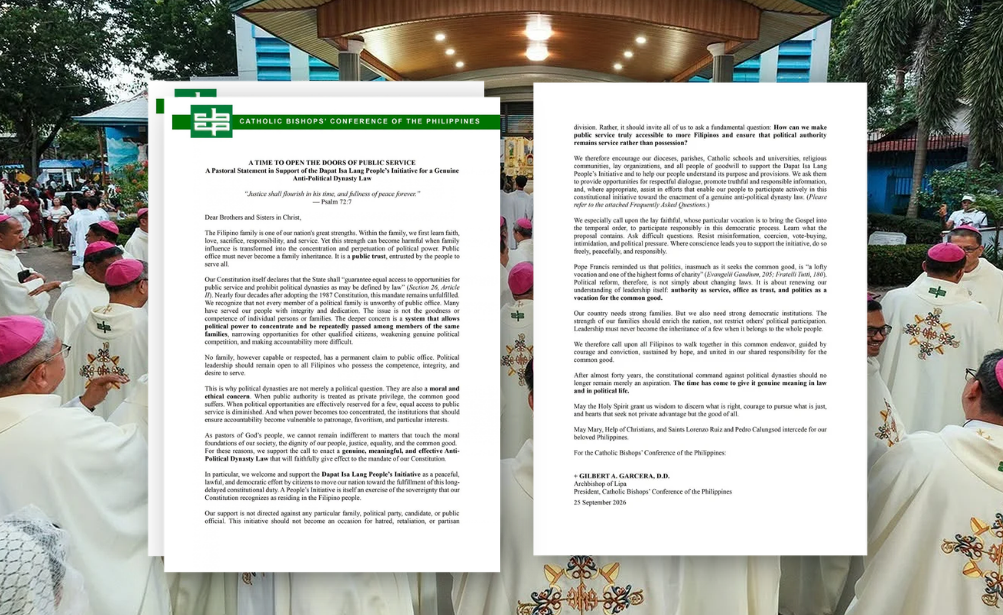
In a pastoral statement, the Catholic Bishops’ Conference of the Philippines (CBCP) expressed support for the Dapat Isa Lang (D1L) People’s Initiative, calling for the passage of a genuine anti-political dynasty law.
Titled “A Time to Open the Doors of Public Service” released on September 25, the statement described that while Filipino families serve as a national strength, its influence becomes harmful when used to concentrate and prolong political power.
“Public office must never become a family inheritance. It is a public trust, entrusted by the people to serve all,” the CBCP stated.
Citing Article II, Section 26 of the 1987 Constitution, the bishops pointed to the mandate requiring the State to guarantee equal access to opportunities for public service and prohibit political dynasties, a provision that remains “unfulfilled nearly four decades after the Constitution’s ratification.”
“The deeper concern is a system that allows political power to concentrate and be repeatedly passed among members of the same families, narrowing opportunities for other qualified citizens, weakening genuine political competition, and making accountability more difficult,” they added.
The CBCP specifically welcomed the D1L People’s Initiative, describing it as a “peaceful, lawful, and democratic effort” toward fulfilling what it called a long-delayed constitutional duty.
Furthermore, the group clarified that its support is not directed against any particular political family, party, candidate, or public official, but a call for greater access to the public service and political authority to remain a form of service rather than possession.
“Our country needs strong families. But we also need strong democratic institutions. The strength of our families should enrich the nation, not restrict others’ political participation,” the CBCP stated.
The statement comes amid renewed debate over the passage of an anti-political dynasty law following a Supreme Court ruling on August 26 concerning Congress’ constitutional duty to prohibit political dynasties.
The ruling discussed a proposed prohibition covering relatives up to the fourth civil degree of consanguinity and cited the concentration of political power among families as a factor that can distort democratic processes, weaken accountability, and create conditions conducive to corruption and political patronage.
D1L spokesperson Carlo Africa welcomed the ruling, but said it would not be enough unless lawmakers also address the substance of the pending anti-dynasty bills.
The bills, Africa said, “do not go far enough to break the concentration of political power within dynasties.”
Meanwhile, University of the Philippines (UP) political science professor Jean Franco also pointed to the presence of political families in the Senate, noting that the chamber currently has four pairs of siblings among its members.
“So it’s still all in the family,” Franco added.
Among the pending measures is House Bill No. 8389, or the proposed Anti-Political Dynasty Act, principally authored by House Speaker Faustino “Bojie” Dy III and House Majority Leader Ferdinand Alexander “Sandro” Marcos.
Approved by the House in June and now pending in the Senate, the bill prohibits spouses and relatives within the second degree of consanguinity and affinity from simultaneously or successively holding certain elective positions within the same locality.
Similarly, the Senate has advanced Senate Bill No. 1901, which seeks to prohibit political dynasties in national and local elective offices and party-list positions and impose penalties for violations. The measure is currently pending on second reading.
In contrast, the D1L People’s Initiative continues its nationwide signature campaign, seeking at least 7 million signatures, equivalent to 10% of the country’s registered voters, for its proposed anti-political dynasty measure. The initiative seeks to cover relatives up to the fourth civil degree of consanguinity and affinity and introduce a one-term cooling-off period.