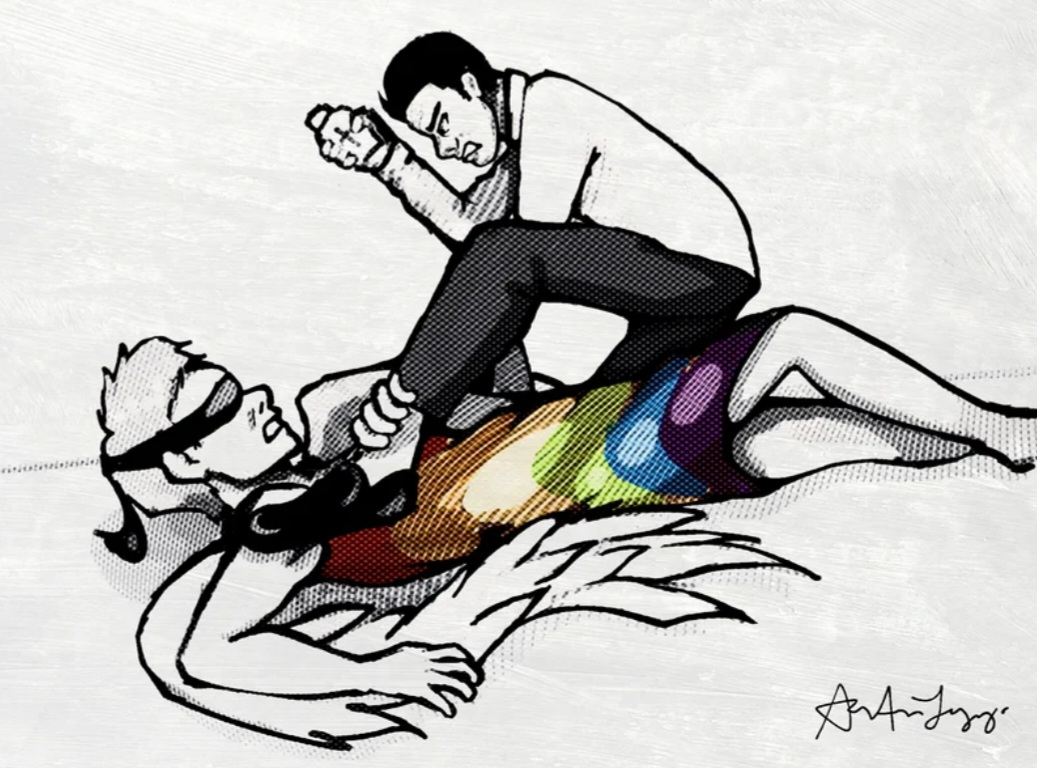
Twinkle twinkle little star, how I wonder what you are?
The year began with a wish—one cast upon a fragile truce, Israel and the Islamic Resistance Movement (Hamas) officially agreed on a ceasefire deal on January 15, which took effect on January 19.
Parents, living or in spirit, kneeled on their knees and thanked Allah—not for saving them, but for giving their children a chance to live. And the kids, both the parented and the orphaned, looked above the horizon of stars.
Yet since January 19, the ceasefire has been little more than ink on paper—Israel has violated it 266 times, leaving 132 dead in Gaza. In southern Lebanon, villages stand in ruin, their silence broken only by the lingering presence of Israeli forces, still gripping five strategic hilltops despite the truce with Hezbollah.
For the children of Gaza, wishes hold no weight. No star has ever stopped an airstrike. No whispered prayer has undone the hunger in their bellies. Their dreams burn to ash in the fires of war, their laughter echoing faintly beneath collapsed roofs and broken bones. The air carries the stench of decay longer than the promise of peace, leaving behind a single, unanswerable question:
What remains to build a future upon when the foundation of your childhood lies in ruins, torn apart by war?
Their right to safety, to food, to learning, to healing shimmers like a diamond in the sky—visible, taunting, forever out of reach. They stretch their hands toward it, but find only smoke, only emptiness. A world that was never theirs refuses to give them even the smallest piece of what should have always been their own.
Blazing Sun of Education
When the blazing sun is gone,
When he nothing shines upon.
The sun and education share a beaming similarity: they are often taken for granted. What others turn away from in discomfort, Palestinian children long for in the dark—gazing at the faint spark of stars, wishing they might guide the sun of education back home.
Rahaf Abu Hashish, 11 years old and a young dreamer, was displaced from her home on the fifth day of the war. She was packed into a tiny tent shared with others who had lost everything. While children elsewhere grow up with cartoons and school lessons, Rahaf’s world is framed by the crack of gunfire, the lifeless bodies of neighbors, and the ruins of a home that now exists only in her memories.
In the article “The War in Gaza Is Having a Catastrophic Impact on Children, Stripping Them of Their Rights” by Sara Bradford, it was reported that children affected by the genocide in Palestine suffer from severe psychological issues.
Yet, hope lingers in Rahaf’s eyes as she finds warmth in the familiarity of her daily routines, especially in their makeshift learning space—a fragile tent-like shelter, held together by tarpaulin sheets and collapsed roofing, where education persists despite the ruins.
“We also study English, and I remembered the names of the colors I had forgotten,” Rahaf shared in an interview with United Nations Children’s Fund (UNICEF).
The school year in Palestine was supposed to begin on September 9, 2024. Yet, even after the ceasefire, colors are about to be forgotten once again as the prospect of a new school year turns into an empty black. In just 100 days since the Israeli bombardment, every school and university in Gaza has been reduced to rubble.
“I miss our home, my bed, and my books. I hope the war stops and we can return to our homes and schools,” she added.
But who will tell Rahaf that even after the war has ended, she no longer has no home, no school, and nowhere to return to?
Food Supply: A Traveler in the Dark
How could he see where to go,
If you did not twinkle so?
Children are often warned to fear travelers in the dark, told by elders that they might take them away from their families. Yet, in a land gripped by severe malnutrition, a traveler in the dark carrying food is no longer a threat—but a prayer answered.
Ten-month-old Saad was carried and birthed as his mother fled the war. Yet, his survival came with its own curse—hunger. Since October 2023, Gaza has suffered a near-total blockade on food supplies. A year later, October 2024 marked the harshest deprivation yet, with food deliveries at their lowest since the war began.
“We live in a tent. Nothing is stable. My husband is unemployed, and I need nutrition for myself because I am breastfeeding and for Saad, who is malnourished,” Najah, mother of Saad, said in an interview with UNICEF.
Najah recalled that when Saad turned seven months, his once-chubby face grew gaunt, and his body seemed to wither.
A gnawing nightmare for a mother unable to do anything but watch his son grow weaker each passing day. The United Nations (UN) estimates that from January 22, over 60,000 children in Gaza will require treatment for acute malnutrition in 2025, with the death toll already rising.
While Gaza has seen a tremendous flow of food supply after the indefinite ceasefire took effect, the UN warns that those who survive and regain nutrition will still face a silent and lingering threat—the severe health problems tied to childhood malnutrition.
“Every time I look at him, my heart aches, and I don’t know if I will lose him or find the right treatment,” Najah said.
Curtains of Healthcare
In the dark blue sky you keep,
Often through my curtains peep
Despite enduring unimaginable hardship, Rafah and Saad still have something to call their own—a name, an identity, a fragile thread connecting them to the life they hold onto.
In Gaza’s Sahaba Medical Centre, Hala cradles her son, born at just 26 weeks—three months too soon. He weighed only a kilogram at birth and now clings to survival, needing urgent neonatal care that no longer exists in Gaza.
El Shifa Hospital’s NICU, once holding 50 beds, is gone. Nasr Hospital’s 20-bed NICU is closed. Kamal Adwan is under evacuation. The only remaining option is the Patient Friendly Hospital, where just three incubators remain—each already occupied by fragile little lives.
Not only is the little boy denied the chance to fight, but he is also denied a name.
His mother, Hala, cannot bring herself to name him—too afraid that if she does, she will have to grieve him.
At night, she pulls back the curtain of Sahaba Medical Centre, not just for privacy but to glance at the stars, fearing her son might soon join them. Yet even the stars are luckier than him, for at least they have names.
Sea of Stars
“Mama, when will this be over? Are we going to die tonight?”
“Say whatever you want to say, but do not say you’re going to take me to my parents. I saw them dying in front of my eyes.”
“Why was my brother killed? What was his fault?”
These are the words of children in Rafah, shared with psychologists from SOS Children’s Villages during one-on-one sessions. Their questions hold a weight far greater than the absence of education, food, or healthcare—they echo the unbearable grief of a stolen childhood.
Gaza’s Health Ministry has confirmed 48,271 deaths in Israel’s war on Gaza while 111,693 people have been wounded since October 7, 2023. More than half of these are children, women, and the elderly.
48,271 deaths. 48,271 stars.
As the universe stretches endlessly, so too does the cycle of violence birthing new stars—each one a life stolen by injustice and genocide.
For the children of Gaza, the night sky is more than just a vast expanse—it is a refuge, the only place where their loved ones remain whole. Up there, they are not decapitated, shot, burned, or buried beneath rubble. They are serene and glowing, resisting the darkness.
An alternate sea, where Palestine is free.
The ceasefire initiated on January 19 ultimately proved futile, as 266 violations were already recorded by February 18.
Back on February 1, wounded Palestinians were evacuated to Egypt for the first time since May—a small step in the first phase of the ceasefire, set to end on March 1. The second phase holds the promise of a full Israeli withdrawal, a permanent ceasefire, the release of captives, and a five-year reconstruction plan. Despite this, uncertainty continues.
In early February, U.S. President Trump called for the depopulation of Gaza and urged the U.S. to assume control of the territory—a move widely condemned as ethnic cleansing. “The U.S. will take over the Gaza Strip, and we will do a job with it, too. We’ll own it,” Trump declared at a press briefing on February 5, 2025. Meanwhile, Israeli leaders continue to entertain the prospect of a return to full-scale conflict, with far-right ministers advocating for a military occupation.
For Palestinian children, survival is not merely a battle of arms but a struggle for resilience against a world that turns a blind eye. Their right to learn, to heal, to simply exist, is stripped from them, leaving them with nothing but the hollow ruins of bombed-out schools, shattered hospitals, incomplete body parts, and fallen loved ones.
Yet, even in the darkest nights, the stars do not vanish. They remain—a quiet rebellion against the void. And so too will the children, guided by their sea of stars, as they reclaim what was stolen. As the stars above continue to shine, so too must the world’s attention, unwavering, on the enduring plight of the Palestinian people.
May the day come when a wish upon a star is no longer a desperate plea, but a future fulfilled.