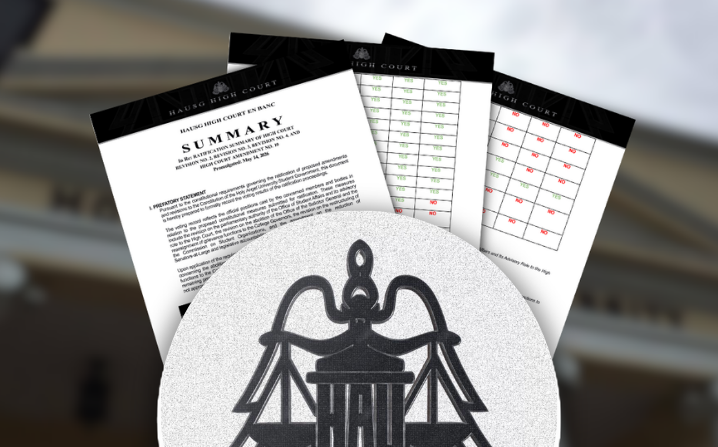
Only one of the four proposed revisions and amendment of the Holy Angel University Student Government (HAUSG) 2024 Constitution secured the required three-fourths vote threshold during deliberations on May 4, with the abolishment of the Office of the Solicitor General (OSG) emerging as the sole ratified measure.
High Court Revision No. 3, which seeks to abolish the OSG and transfer grievance authority to college governors, will advance to a student-wide plebiscite on May 22.
Meanwhile, High Court Revisions No. 2 and No. 4, along with High Court Amendment No. 10, all failed to pass based on official results.
High Court Revision No. 2 received 21 affirmative votes against 13 negative votes, while Revision No. 4 recorded 20 affirmative votes against 14 negative votes. High Court Amendment No. 10, meanwhile, garnered 18 affirmative votes against 16 negative votes.

Composed of 34 members, the deliberating body included the HAU – University Student Council (HAU-USC) president, College Student Council (CSC) governors, High Court justices, the University Senate, and Commission on Student Organizations (CSO), Commission on Financial Audit (CFA) chairpersons, and Commission on Elections (COMELEC) chairpersons.
High Court Revision No. 2 sought to designate the Office of Student Affairs (OSA) through its Student Activities Coordinator or authorized representative as the central parliamentary authority of the HAUSG while maintaining the High Court’s judicial independence.
Conversely, High Court Revision No. 4 proposed a sweeping overhaul of the Commission on Student Organizations (CSO) that would replace its current fixed-term system with a permanent, tenure-based framework.
High Court Amendment No. 10, on the other hand, intended to reduce the number of senators-at-large in response to its legislative inactivity, underperformance, recurring limitations in the pool of candidates for at-large positions, and the incidence of vacancies within the University Senate.
Sole accepted proposal Revision No. 3 seeks to transfer grievance authority directly to college governors, citing the College Student Councils’ (CSCs) role as the “primary frontline representatives” of students within their respective colleges.
This also institutionalizes a monthly coordination between the HAU-USC president and the CSC governors for the elevation, monitoring, and resolution of student grievances affecting one or more colleges.
In an interview with outgoing HAU-USC President Adonis Cayanan, he explained that the revision formalizes an already existing practice among the CSCs.
“In the past, and even up to now, the College Student Councils have been the ones directly coordinating with their respective College Deans, which made addressing student concerns more efficient,” Cayanan said.
He added that most concerns raised by students involve faculty evaluations, campus facility issues, and similar matters usually specific to a particular college, while only a limited number involve multiple colleges at once.
Cayanan also clarified that there will be no affected student grievances.
“At present, there are no pending grievances being handled by the Office of the Solicitor General, so its abolition will not affect any existing cases,” he said.
Outgoing Solicitor General Charles Lansang shared that most concerns were already college-specific in nature and were often endorsed to the respective CSCs for direct action.
“In my experience, I can say that the current structure has somehow become less necessary, mainly because most of the concerns received by our office are college-specific in nature,” Lansang explained.
“Since the CSCs are closer to the students and the college administration, many concerns are resolved more efficiently at that level,” he added.
He also noted that the abolition of the office would discontinue its operations in succeeding terms, with responsibilities previously handled by the office likely to be transferred to and absorbed by the HAU-USC President.
Meanwhile, with the rejection of the two revisions and one amendment, Cayanan stated that adjustments would still need to be made in preparation for the next term.
“One immediate concern is that the current number of elected Senators is insufficient, which means appointments are expected to fill the remaining positions,” he said.
“In addition, a new set of commissioners under the CSO will also be needed. Because of this, it is important for both the outgoing and incoming officers to have a proper and organized transition process in the coming weeks before the next term officially begins,” Cayanan added.
Incoming HAU-USC President Aerith Catap shared that the concerns raised by the rejected revisions and amendment would still be addressed by the next administration despite failing to secure the required approvals.
He stated that these proposals were rooted in existing issues within the student government.
“Thus, I do not believe that the end of a proposal should also mean the end of the conversation surrounding the issues it sought to resolve,” he explained.
Catap added that these concerns are to be addressed through “concrete and immediate measures” within the powers already granted by the constitution, while also elevating the matters for further deliberation during the first joint assembly for A.Y. 2026-2027.
Following the ratification of Revision No. 3, COMELEC has scheduled a student plebiscite on May 22 to ratify the said constitutional change.