Citing the university’s adherence to the “established enrollment and processing schedule for orderly and efficient operations,” HAU turned down a proposal to release the schedule of partial payment slips in advance, May 28.
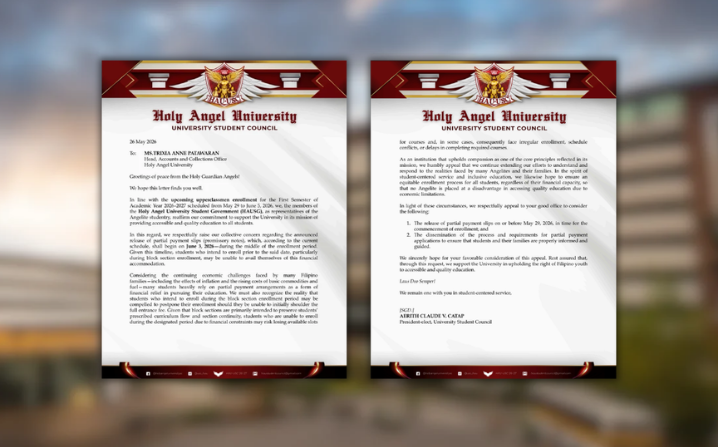
This comes after the HAU Student Government (HAUSG) formally appealed to the Accounts and Collections Office (ACO) May 26, ahead of upperclassmen enrollment for the first semester of Academic Year 2026–2027.
Citing potential financial barriers, HAUSG flagged concerns on the release schedule of partial payment slips set for June 3, noting that enrollment begins on May 29, which may disadvantage students unable to pay full entrance fees during the initial block section enrollment period.
Further, delays in the release of partial payment arrangements may result in financially constrained students losing block section slots or experiencing irregular enrollment.
The issue surfaced after several students raised concerns via Messenger on the HAU – University Student Council (HAU-USC) Facebook page, questioning how they would be able to enroll if they are unable to pay the entrance fee on time.
Initially, an in-person meeting of HAU-USC President-elect Aerith Claude Catap and the ACO took place on May 26, where the proposal was rejected by the latter. A second appeal via Outlook email on May 27 likewise received a final rejection on May 28.
Despite acknowledging the concerns, ACO Officer-in-Charge Trixia Anne Patawaran responded that the university will retain the current enrollment and payment processing schedule.
She added that the timeline was “carefully set” to accommodate students unable to pay on time.
“The announced release date for partial payment slips, starting on June 3, 2026, was carefully set to accommodate students who could not pay on time and can still enroll after their scheduled enrollment date,” Patawaran’s email reply read.
In an interview, Catap revealed that he was “not really convinced” with the admin’s reasoning.
“The reason why it was released that late at hindi siya sinabay sa mismong date ng enrollment was to give privilege daw sa mga makakapagbayad ng entrance fee in full,” Catap recounted.
He said the reason was not convincing, noting that consideration must be given to the realities of students, and that many students may struggle to pay entrance fees in full amid block enrollment requirements.
“…and given the concerns din na may mga enrollees na hindi nakakapasok sa block sections or nawawalan ng slot sa mga specific subjects, so kailangan nilang i-retake ‘yon sa another year,” he further spoke on the USG’s appeal.
Despite this, Catap suggested that the College Student Councils (CSCs) “create interventions within their respective colleges,” adding that they may assist students unable to pay in reserving their block sections amid ongoing block enrollment.
He further cited coordination with the HAUSG Senate to provide statistical supplement data for a re-appeal.
“As another intervention, the USC will also coordinate with the Senate to research and provide statistics on current financial outlook of students, as another push to release promissory notes early during the 2nd Semester enrollment,” he stated.
The president-elect further shared that, if given the opportunity to speak to the administration, he would call for “just a little more compassion” toward students, emphasizing the difficulties they are currently facing.
“A better outlook din in the current student realities is that we must not only give privilege to those who can actually pay in full, but provide an equitable access to enrollment regardless kung ano ‘yung financial capabilities ng isang estudyante,” he concluded.