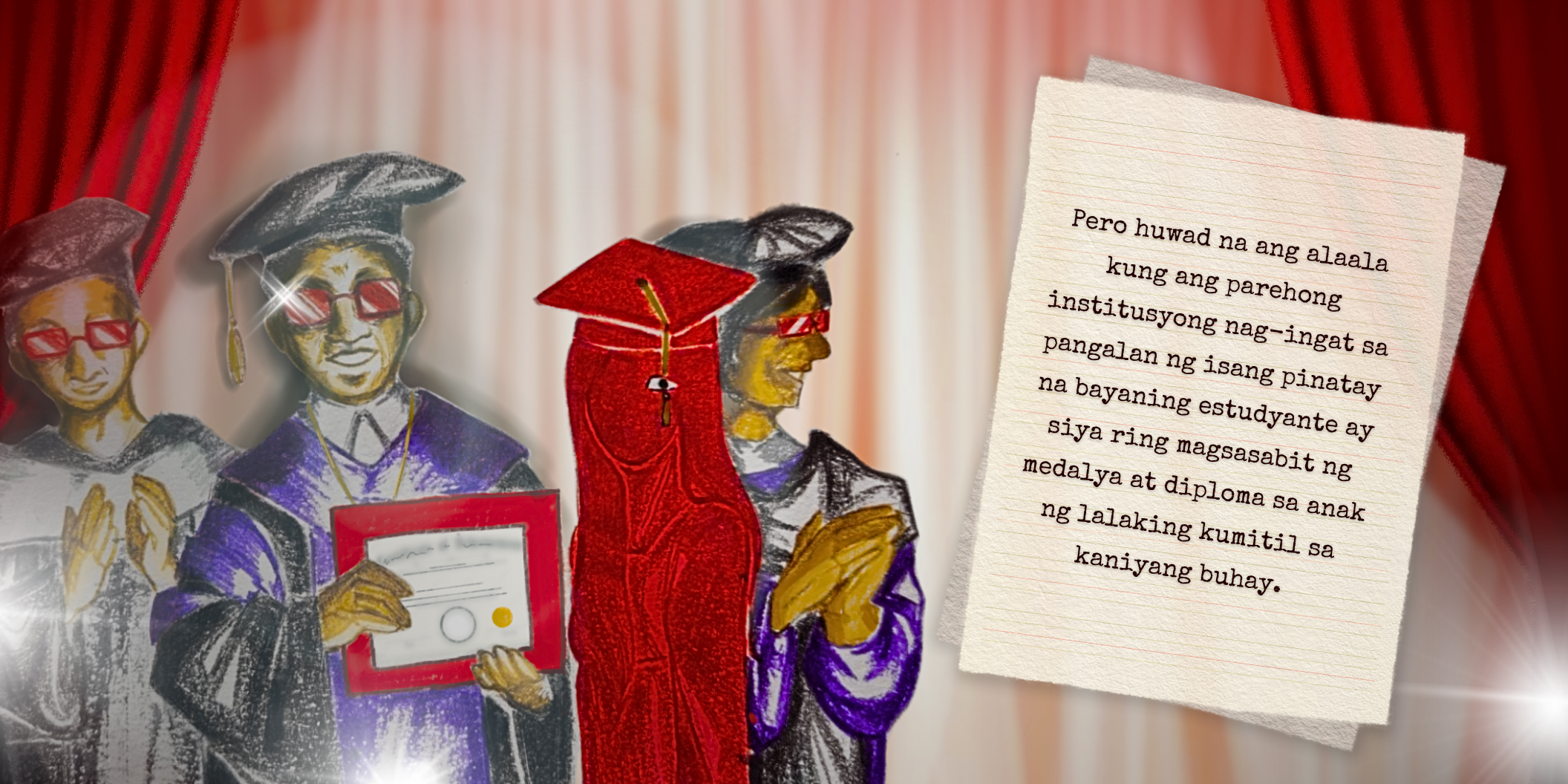
In the high-stakes chess match of Philippine politics, the board is blemished by a crack—one that tramples principles beneath the weight of political expediency, where survival demands strategy at the cost of integrity.
On the center of the board stands Former Vice President Maria Leonor “Leni” Robredo, heralded as a beacon of principled resistance, having made a gambit that raises a question: is it her direction that is shifting or is the game itself fundamentally broken?
Her endorsements of senatorial candidates Benhur Abalos, Manny Pacquiao, and Rodante Marcoleta—figures tied to democratic suppression, conservative punity, and Duterte apologism—jarred the very base that once rallied under her pink banner.
As the game prevails, let us navigate how to move forward when even the most earnest leaders forge alliances that appear antithetical to the values they once championed.
A queen for the people
To understand the stakes, it is imperative to first confront what Leni Robredo once stood for and what her recent choices now challenge.
Robredo rose to prominence not just as the widow of Jesse Robredo, but as a public servant who built a legacy rooted in moral clarity—opposing extrajudicial killings, defending human rights, and calling out impunity even when it came at the cost of ridicule, red-tagging, or political isolation.
“Hope is the currency of changing governance,” remarked Brandon De Luna, a political public relations practitioner and instructor at Holy Angel University (HAU).
In 2022, that currency flowed through the veins of a campaign that she erected not by machinery—but by a movement.
It did not rely on dynastic power or transactional politics, it was propelled by volunteers, the youth, artists, activists, and everyone who saw her not just as a candidate, but as a cause, a beacon of hope.
The movement she galvanized, one aptly coined the “pink movement,” was built on one line: that politics could still be principled.
In Dipolog City, days before the election, Robredo said, “Kung hindi ka lilinya nang malinaw; kung makikipagkompromiso ka; kung hindi mo man lang kayang sabihin [na] mali ang mali—kaninong panig ka ba talaga?”
Back then, it was not just rhetoric, she had drawn the boundary—no compromise with corruption, no alliances with enablers, no return to the politics that brutalized a generation.
That is why when news broke of her endorsement of Marcoleta, Abalos, and Pacquiao, it was not merely seen as a political strategy—but by her supporters, as a move that felt like a betrayal and a departure from the ideals of the pink movement.
The three power players
Grasping the magnitude of the backlash against Robredo warrants confronting why the three endorsements she made are seemingly dissonant to her reputation.
Robredo formally endorsed former Department of the Interior and Local Government (DILG) Secretary Benhur Abalos for the Senate in April 2025, hailing him as a “competent public servant” despite a record that appears at odds with her own stance on justice and accountability.
As the DILG secretary under the Marcos Jr. administration, Abalos oversaw the supposed “internal cleansing” of the Philippine National Police (PNP). Yet in January 2023, he announced in a Camp Crame press conference that senior police officers linked to the illegal drug trade—but without “strong enough” evidence—would be quietly allowed to retire.
“We’ll let them retire peacefully,” he said, adding that there was no need to publicly name them. This approach appeared to have protected powerful officers from scrutiny and enabled the culture of impunity Robredo had once vowed to dismantle.
In 2016, Robredo even released a video statement where she condemned the war on drugs, calling it a “failed policy” that disproportionately affected the poor and vulnerable. She highlighted the need for a compassionate, rights-based approach to the drug problem, which aligned with her consistent messaging on protecting human life and dignity.
In the same event, Robredo also threw support behind Manny Pacquiao’s Senate comeback bid in April 2025, describing him as a “longtime ally in public service.” The move baffled advocates of progressive values, given Pacquiao’s deeply conservative and punitive politics.
In 2018, Pacquiao publicly supported the reimposition of the death penalty, invoking biblical authority. “Binibigyan ng karapatan ang government to enforce death penalty,” he said on an interview with DWIZ.
His stance stood in contrast to Robredo’s defense of the sanctity of life. Throughout her term as vice president, especially in her tenure as co-chair of the Inter-Agency Committee on Anti-Illegal Drugs, she consistently advocated for reforms that focused on transparency, due process, and the protection of citizens’ rights.
Though Robredo did not officially include Rodante Marcoleta in her endorsement list, her public introduction of him during a campaign event in April 2025 sent an alarming signal.
“I-welcome po natin—Senator na, hindi na Congressman—Senator Rodante Marcoleta,” she said, smiling as he stepped on stage. The optics and language amounted to tacit endorsement.
But Marcoleta is no ordinary candidate, for his political actions have drawn attention and criticism. For instance, in 2017, he led the push to slash the Commission on Human Rights’ budget to ₱1,000 at the peak of the drug war. He also played a central role in the shutdown of ABS-CBN, which Human Rights Watch called a “political vendetta.”
He has publicly defended red-tagging by claiming that criticizing the government “invites” it, and, just this April 2025, he backed Vice President Sara Duterte’s confidential funds, arguing that legislative oversight was unfair, even as economic hardship crushes Filipinos.
These are not pawns—these are power players who stood diametrically opposed to the ideals she once guarded. To align with them is not just pragmatic—but it may also be interpreted as ideological checkmate.
Cost of the queen’s gambit
Endorsements are never neutral. In politics, they are not mere gestures of support—they are acts of legitimization.
They signal alignment, even partial, with a candidate’s values and history. In the Philippine context—where political dynasties and patronage systems dominate—such alliances can either crack open the door to reform or bolt it shut to reinforce the status quo.
“When you endorse personalities of questionable character, it leads people to question your credibility,” De Luna warned, further stating that it “affected her brand, and that brand was her most valuable political asset.”
But this is not a simple story of a supposed betrayal. To flatten it into a narrative of duplicity—calling Robredo “two-faced”—is to miss the deeper complexity of the terrain she seems to be navigating. This is not just a story of one leader’s choices; it is a reflection on what it takes to stay alive in a political system designed to strangle reformers with the very ropes they try to cut.
Robredo’s allies have attempted to frame her endorsements as political necessities.
Senator Kiko Pangilinan called the endorsements her “prerogative,” while Senator Leila de Lima emphasized her long-standing commitment to inclusive leadership, even when decisions were “not easy to explain.”
In a system rigged against idealists, maybe she believes you need to “choose your battle, what you can tolerate, what you can add so that you can leverage it for tomorrow,” as suggested by Mr. De Luna.
This sentiment finds echoes in the analysis of political scientist Richard Heydarian, who suggests that Robredo’s move is part of a longer game—an attempt at “coalition-building” to establish a “new center of gravity” across polarities.
Ronald Llamas, her former political adviser, describes it as a play for addition, not subtraction—a classic strategy in Philippine elections, where broad alliances are often seen as a necessary evil.
Now, the question remains—when power and influence are added, what is subtracted?
What is truly lost when a leader compromises is not merely credibility—it is hope.
When she made moves that conceded moral integrity, it dug a grave for the roses, pink flaglets, and “liwanag sa dilim” anthems that once filled the roads of EDSA—the collective aspiration of “fighting the good fight.”
The backlash was heavy with the weight of disappointment. Labor leader Luke Espiritu, who ran under the same progressive banner Robredo once inspired, voiced his dismay on social media, stating that neither Abalos nor Pacquiao “deserve” her endorsement.
A post by We The Pvblic also gained traction, saying, “just factions of the same political elite. From Aquino to Arroyo, from Duterte to Marcos—the brand may shift, but priorities rarely do.”
These sentiments lie beneath the confines of realpolitik—politics based on practicality over ideology—reverberating a solemn truth: with Abalos, Pacquiao, and Marcoleta brought into her corner, Robredo made a gambit that feels like a checkmate on not just her integrity—but also on the progressive ideals that she once swore to protect.
Hate the game, not just the player
It is easy to direct anger toward Robredo, but to stop there would be to miss the deeper meaning—that it cannot merely be perceived as a lapse in her personal judgment, but rather as the bitter symptom of a political architecture designed to erode conviction in personal ideologies.
In a country where power is concentrated in dynastic hands, where party systems are hollow and patronage is the prevailing logic, the very architecture of politics is hostile to the principled progressive.
Mr. De Luna puts it plainly: “You cannot change the game if you cannot play the game first.”
He expounds, saying, “If you want to win, yes, push for ideal candidates—but play the game, win it, and change the rules thereafter.”
The logic may be valid, but may also be dangerous, because every compromise made to win today risks entrenching the very system intended for reform tomorrow.
That is the deeper tragedy—when the system is rigged, it renders moral integrity a liability rather than a strength. It reinforces the narrative that transactional politics is imperative to maintain influence or even to just survive.
And in the revolutions of that cycle, the country is trapped with choosing who the lesser evil is.
This is not to absolve all responsibility, but to contextualize it: the betrayal many feel is not just about Robredo’s decision, but about a democracy that continues to make such choices inevitable.
So, the challenge is clear—to demand more from leaders, it is essential to also demand more from systems. Let this be a call not just to grieve what was lost, but to fight harder for what must be rebuilt.
Breaking the board
The logic of political necessity insists: play the game to win, compromise to survive, ally with power to gain power. But this logic, while seductive, is a slow poison. It asks for the erosion of values piece by piece, until the original principles are forgotten.
If the system demands compromise to win, then refusing to win on its terms becomes essential.
Change has never come from those who conformed to the rules of a corrupt game. It came from those who refused to play by them: workers who struck, students who marched, women who ran for office not to be palatable, but to be unrelenting.
The truth is, when victory is achieved by playing their game, then the loss has already been suffered.
The only way to change the game is to change the terms—through people-powered organizing, values-based leadership, and radical hope that refuses to settle.
Let this be the masses’ move: not silence, not surrender, but uprising—of clarity, of conscience, of collective power. Because the game may be rigged, but survival on its own is not the goal
The play, at its core, is to move toward reform.