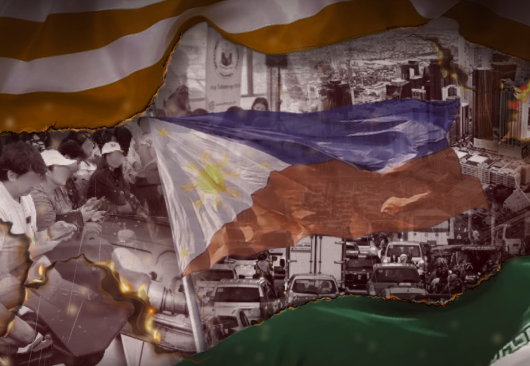
When the US dropped bombs on Iran, the blast echoed across oceans — not with missiles or fire, but in fare hikes, dwindling remittance queues, and half-empty dinner tables.
Tensions spark in the Gulf, oil markets flinch, and halfway across the world, the Philippines bears the cost of a war it never chose — tethered by oil, labor, and loyalty to a superpower that writes the script while we pay the price.
Bound by oil dependence, labor export, and military ties to the US, the country is once again caught in a conflict it never chose but will pay for all the same.
Here, war comes in subtler forms: a jeepney fare hike, a withheld remittance, a grocery list trimmed down to essentials. For millions already living paycheck to paycheck, the cost of a foreign missile is measured not in megatons, but in pesos.
Why a Foreign War Feels so Close
Importing more than 80% of its crude oil, the Philippines relies heavily on external markets to power transport, agriculture, and industry — rendering it exceptionally vulnerable to shocks in global oil prices.
Now, as the conflict escalates in the Gulf region, global oil prices are beginning to surge.
Jetti Petroleum President Leo Bellas warned that world oil prices could climb further in the coming days, not just due to supply concerns, but because of rising premiums and shipping costs driven by the expanded scope of armed conflict.
“The potential increase in premium and freight, which are projected to rise because of the expanded scope of hostilities, could be factored in the expected movement on domestic prices,” he noted.
His statement zeroes in on what many transport workers and commuters already feel in real time: that in every peso added at the pump, there is a freighted consequence — one that traces back not just to oil costs abroad, but to how quickly tensions escalate and how little protection local consumers have.
On July 8 alone, Dubai crude — the benchmark for Philippine oil imports — rose above $90 per barrel. Locally, pump prices soon followed. The Department of Energy projected domestic increases of up to P4.80 per liter for diesel and P3.20 for gasoline as of June 21. The impact? Fuel prices have reached over P70 per liter.
For many Filipinos, that number is more than a statistic.
As journalist Cai Ordinario wrote, inflation does not stop at prices. It influences wage demands, employment rates, and can trigger job displacement. The smallest hikes are felt most by the poor, magnified by the state’s inaction.
Public utility drivers are among the first to feel the shock. Their earnings, already meager, are swallowed by the mounting cost of fuel — forcing them to work longer hours for less take-home pay.
In Central Luzon, transport groups have filed for a minimum P2 fare increase, citing financial strain due to rising fuel costs and other operational expenses. The Land Transportation Franchising and Regulatory Board (LTFRB) has acknowledged the pressure, but aid remains elusive.
Higher transport costs ripple outward with brutal efficiency.
When diesel prices surge, so do the costs of shipping vegetables from Benguet and sacks of rice from Nueva Ecija — regions that feed much of Luzon’s wet markets. In turn, vendors pass the burden onto consumers, forcing households to make quieter compromises: less ulam, fewer grocery runs, another staple removed from the week’s list.
A P3 increase at the pump may seem marginal to policymakers, but for families already operating on razor-thin budgets, it can mean a full meal lost. This chain of cost, triggered by decisions made in foreign war rooms, reaches into Filipino kitchens faster than most headlines do.
OFWs in the Crossfire
In a conflict not of their making, more than 30,000 Overseas Filipino Workers (OFWs) in the Middle East brace themselves for impact — not from bombs, but from silence; finding themselves on the frontlines of a war that speaks their names only when the remittance stops.
From Saudi Arabia to Qatar, many OFWs continue to work in service, construction, and healthcare — sectors deeply intertwined with the region’s economic stability. Yet with every missile launched, the threat of repatriation, withheld contracts, or even targeted violence looms larger.
In a June 2025 interview with DZMM, economist and former Bangko Sentral ng Pilipinas (BSP) Deputy Governor Diwa Guinigundo warned that the conflict could trigger a flight to safety in global financial markets, pushing investors toward US government bonds.
“Now that the US has joined the war in Iran, the whole world market is rattled,” Guinigundo said.
He noted that as investors exit riskier currencies like the peso, the Philippine currency weakens — and the peso-dollar exchange rate becomes yet another battlefield where Filipinos quietly bleed.
A weakening peso only compounds the inflationary pressure already set off by the oil spike. It also erodes the value of remittances sent by OFWs — the very backbone of many Filipino households.
“We must recognize that a geopolitical event like this doesn’t just impact global markets; it immediately affects remittance-dependent families. These remittances represent a lifeline for millions. Any disruption could ripple across local economies,” Guinigundo noted.
His words remind us that behind every statistic is a household balancing tuition fees, grocery budgets, and medical bills on a monthly cash transfer from abroad. When war disrupts this flow — even temporarily — it is not just an economic hiccup. It is a mother who can’t send money for her child’s school supplies, or a family that delays hospital care.
This vulnerability extends beyond pump prices. Over 30,000 Filipinos are deployed across the Middle East — living, working, and remitting from regions now shadowed by conflict.
These are not just numbers on a flight manifest: they are breadwinners, lifelines, and anchors of entire households.
Should hostilities intensify, families risk losing not only their income, but their only connection to security: missed wages, disrupted communication, severed contracts, and forced repatriation. In these precarious moments, what disappears first is not just opportunity, but choice.
And for many Filipino families, losing an OFW job can mean losing everything.
Bonds That Bleed
These vulnerabilities are not new. They are symptoms of a deeply embedded economic structure — one reliant on external labor markets, foreign military pacts, and imported energy.
The country’s enduring alignment with the US, cemented through decades of treaties like the Enhanced Defense Cooperation Agreement (EDCA) and the Visiting Forces Agreement (VFA), continues to dictate both foreign and domestic policy. Under the Marcos Jr. administration, these ties have only deepened.
While these agreements are often branded as strategic or protective, the burden is felt far from airbases and policy tables. It materializes in shrinking paychecks, pricier goods in the palengke, and jeepney fares that outpace stagnant wages.
This is the unspoken compromise: to stand with superpowers is to absorb the economic backlash of their wars.
President Ferdinand Marcos Jr. recently downplayed the war’s local impact, stating, “So far there is no significant effect in the economy.”
But this statement stands in stark contrast to projections from BSP Governor Eli Remolona, who warned that inflation could breach 5% if Dubai crude reaches $100 per barrel and the peso weakens further.
“World oil prices could rise further because of the new development,” echoed Bellas, noting that premium and freight costs — factored into the pump price — will surge as hostilities expand, proven by the rise of P4.80 per liter for diesel in the country.
Economist Juan Paolo Colet further emphasized that “our policymakers must look beyond the current conflict… and make our country resilient to oil shocks.”
He proposed long-term solutions lie on “investing in mass transit systems, fast-tracking renewable energy and battery energy storage, and promoting electric vehicles” — not in reactive subsidies or diplomatic downplaying.
But so far, the country’s response has been muted, shaped more by appeasement than by proactive preparation.
In a global market ruled by fear and speculation, panic alone caused oil prices to spike by 12% in three days — without any actual supply shortage. With domestic refining capacity all but dismantled and oil production virtually nonexistent, the Philippines faces these tremors without a cushion, exposed to every fluctuation dictated abroad.
With domestic oil production virtually nonexistent and refining capacity has dwindled, Filipinos are left at the mercy of international suppliers.
Tuition, Transit, and a Nation Stretched Thin
For many students, the cost of war does not come in air raid sirens or conscription, but in longer walks to class and meals quietly skipped. As fuel prices surge and public transport operators raise fares to stay afloat, daily commuting becomes a luxury that not everyone can afford.
In a country where remittances account for over 11% of the gross domestic product (GDP), disruptions caused by Middle Eastern conflict stretch beyond overseas households — they seep into classrooms, campuses, and canteens.
When remittances falter and transportation costs rise, school becomes harder to reach, literally and financially.
“Imbes na mapupunta sa pagkain, ‘yung pera ko mas napupunta sa pang-gas — and as a student, mahirap mag-budget,” said Brian Solanes, a 21-year-old student motorist who pays for his own fuel.
Brian’s daily reality reflects a broader crisis: students juggling academic commitments with economic survival, often forced to choose between education and essentials.
Jeepney and tricycle drivers, whom he rides alongside, are also stretched to their limits — squeezed between rising fuel prices, vehicle maintenance, and inadequate government support. Push comes to shove, they often take home less than what they spent akin to a worn-out engine running on fumes.
“Para sa’kin, mas apektado talaga ang mga namamasada sa kalsada. Mas humihirap ang hanapbuhay nila,” he added.
On top of this, continued alignment with the US reduces mobility of public transportation scrambling to recover from fuel costs. This grim reality falls hardest on the younger demographic like basic education and college students.
Daily commuters will most likely feel the strains of having to walk, bike unsafe roads, or worse, skip school simply because they can no longer afford the fare hike.
Sovereignty Beyond Speeches
Missiles may not fall on our soil, but the blast reaches us all the same. In this country, war creeps not in gunfire, but in the slow erosion of dignity; in empty bowls, in lost remittances, in classrooms students can no longer afford to reach.
And yet, many remain emotionally and physically distant from such issues. They scroll past news of it on our ‘For You’ page, thinking of it as just another headline. Another warning. But in reality, we’re reenacting the nightmare.
But this detachment is not ignorance, it is conditioning.
It stems from decades of systemic upbringing that has taught us to accept suffering as inevitable, and dependency as necessary; from burying the mechanics of war beneath economic reports, diplomatic statements, and technocratic jargon.
True sovereignty is not declared in speeches, it is asserted in systems. It lives in policies that put Filipinos first: in publicly owned and operated transit, in local oil reserves, in energy that is sustainable and ours.
It lives in breaking free from military treaties that make us a pawn in wars not of our choosing, and in reclaiming the power to say “no” — to bombs, to bargains, to borrowed security.
We must no longer be satisfied with survival while foreign powers profit. The path forward demands more than resilience; it demands reckoning. We must dismantle the colonial scaffolding that still props up our economy and our foreign policy, and rebuild one rooted in genuine independence, dignity, and care for our people.
Until we do, we will continue to be the collateral damage of other nations’ wars — bearing the costs, but never reaping the peace.