Following a series of bomb threats in Pampanga universities since early October, Safety and Discipline Coordinator Mr. Melvin Layon relayed HAU’s safety protocols — including threat verification before crisis communication, class suspensions when necessary, and educational campaigns on crisis operations.
In an interview, Mr. Layon clarified that reported bomb threats do not automatically warrant class suspensions, stressing that “the safety department should first verify the legitimacy of the threat before making a decision.”
“Verify muna, and hindi agad yung walang pasok. Vine-verify yon. Ako mismo ‘yung unang nagve-verify no’n, iche-check kung legit ‘yon or hindi. Katulad ng earthquake, hihintayin niyo muna ‘yong verification ng security, iche-check ‘yong building, ve-verify kung stable ‘yong building, [kung] walang problema, balik sa school, [kung] wala tayong problema balik tayo sa klase,” Mr. Layon explained.
He further emphasized that the verification process must be completed before disseminating any information to the university community. “Hindi mo pwedeng ibroadcast kasi iche-check mo muna ang area kung may legitimacy,” he added when asked about class suspension and crisis communication policies.
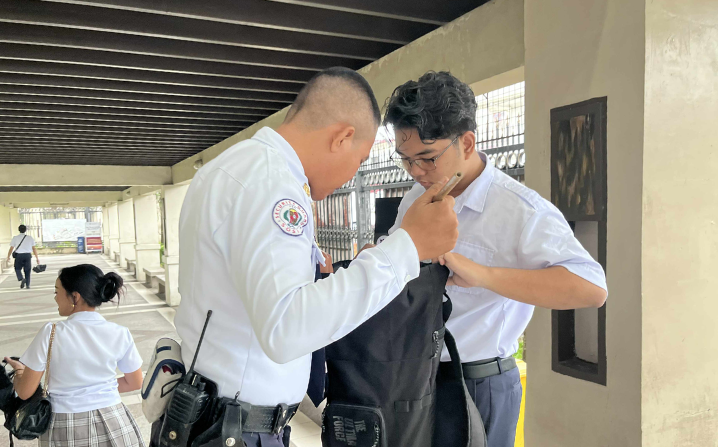
Mr. Layon also directed the security department to implement heightened security measures, including discreet monitoring, random inspections, as well as bag and vehicle checks at campus entry points. He explained that these measures are applied based on the urgency of a situation rather than conducted randomly.
Included in the tightened security measures was the “strict enforcement” of wearing prescribed uniforms in order to distinguish HAU students from visitors and the identification of “suspicious items” such as wires, large batteries, or generally unusual objects not normally carried by students.
“Sabi ko lahat ng estudyante to wear their prescribed uniform, lahat ng bisita iche-check, ive-verify saan sila pupunta kasi para caution. Kasi ‘yong nangyayari sa labas, advance thinking kasi kapag safety officer ka kasi, ina-advance mo sarili mo na possible na may mangyayari kahit hindi totoo,” the safety and discipline coordinator expressed.
“Kung mayroong may paghihigpit, ‘yon ay para sa inyo. Hindi ko hinihigpitan ‘yong campus para mawala ‘yong pag-iisip niyo [na], ‘ay, nagre-relax lang ang school.’ Kapag nakikita niyo na may nangyayari sa labas, proactive kami na [mag]higpit na as in check lahat, pati ‘yong mga estudyanteng hindi nagu-uniform, sabi ko pauwiin niyo,” he stated.
Even with the circulation of online posts alluding to bomb threats, Mr. Layon noted that there were ethics the university “needs to follow” in order to push through with the investigation, although some are intentionally kept confidential to maintain an element of surprise and ensure effectiveness.
“‘Di lang namin sinasabi sa inyo (students) kase para surprise, para hindi niyo alam na mayroon kaming ginagawang safety sa lahat ng mga community natin, kasi ‘yon ang pinaka-number one,” he stated when asked about the standard procedures for security of the university.
According to Mr. Layon, the university is currently preparing a series of awareness campaigns and safety drills covering scenarios such as earthquakes, fires, bomb threats, and possible active shooting incidents. These include the distribution of videos detailing safety protocols for broader information dissemination.
Pampanga univs face surge of bomb threats
Multiple bomb threats have been reported from universities within Pampanga — the earliest being consecutive reports on October 6 involving Pampanga State University’s (PSU) Bacolor and Mexico campuses, Pampanga Colleges in Macabebe, Holy Cross College in Sta. Ana, and Our Lady of Fatima University (OLFU) in the City of San Fernando. Class suspensions and evacuations were announced shortly by each of the universities.
National University (NU) – Clark, Angeles City National Trade School (ACNTS), and the University of Assumption (UA) also evacuated their students from their respective premises upon receiving bomb threat reports on October 7.
The City College of Angeles (CCA) had also received bomb threats on October 8, which was succeeded by another series of reports from Francisco G. Nepomuceno Memorial High School, October 9.
Investigations confirmed that no explosive devices were found in any of the universities.
In response to the hoaxes set by various bomb threats in the province, Pampanga First District Representative Carmelo “Pogi” Lazatin requested for an investigation in which he requests to file cases against the perpetrators for the instances of bomb threats across Angeles City following the bomb threats against F.G. Nepomuceno Memorial High School.
“These false bomb threats have caused enough undue worry and stress to the members of our community and it has to stop,” Lazatin stated in a letter to Brigadier General Bernard Yang of the PNP Anti-Cybercrime Group on October 9.
Karapatan CL II raises concern over threats
Following reports of bomb threats, human rights group Karapatan Central Luzon II expressed alarm over the potential jeopardizing of civil liberties in the name of public safety — citing concerns over alleged statements from the Pampanga Police Office suggesting the enactment of the Anti-Terrorism Act of 2020 in managing the province’s bomb threats.
“Investigations must be pursued with utmost diligence, transparency, and respect for due process—not under a climate of intimidation or political convenience,” Karapatan stated, adding that the Anti-Terrorism Act should not be invoked without “clear, direct, and compelling evidence of terrorism” per the law’s own provisions.
“We remind the authorities that Presidential Decree No. 1727 (1980) remains the relevant statute for penalizing false bomb threats. To apply the Anti-Terror Law in such cases is grossly disproportionate and risks repeating the very abuses it claims to prevent. True rule of law requires restraint, not overreach,” the group added.
Karapatan also raised concerns over the potential framing of campuses as “danger zones” — cautioning against heightened military presence in schools as a response to bomb threats.
“The sudden wave of “bomb scares” in schools cannot be divorced from the broader political context. When fear spreads in the public sphere, it becomes easier to justify heightened police presence, surveillance, and control — especially in spaces where students, teachers, and communities have recently begun to organize and protest,” Karapatan asserted.
At the end of their statement. Karapatan voiced out their calls for accountability and transparency, calling for evidence-based and right-compliant investigations into the bomb threats in Pampanga. They also called for the disclosure of all digital forensics measures, such as cyber warrants and data requests to ensure accountability.