
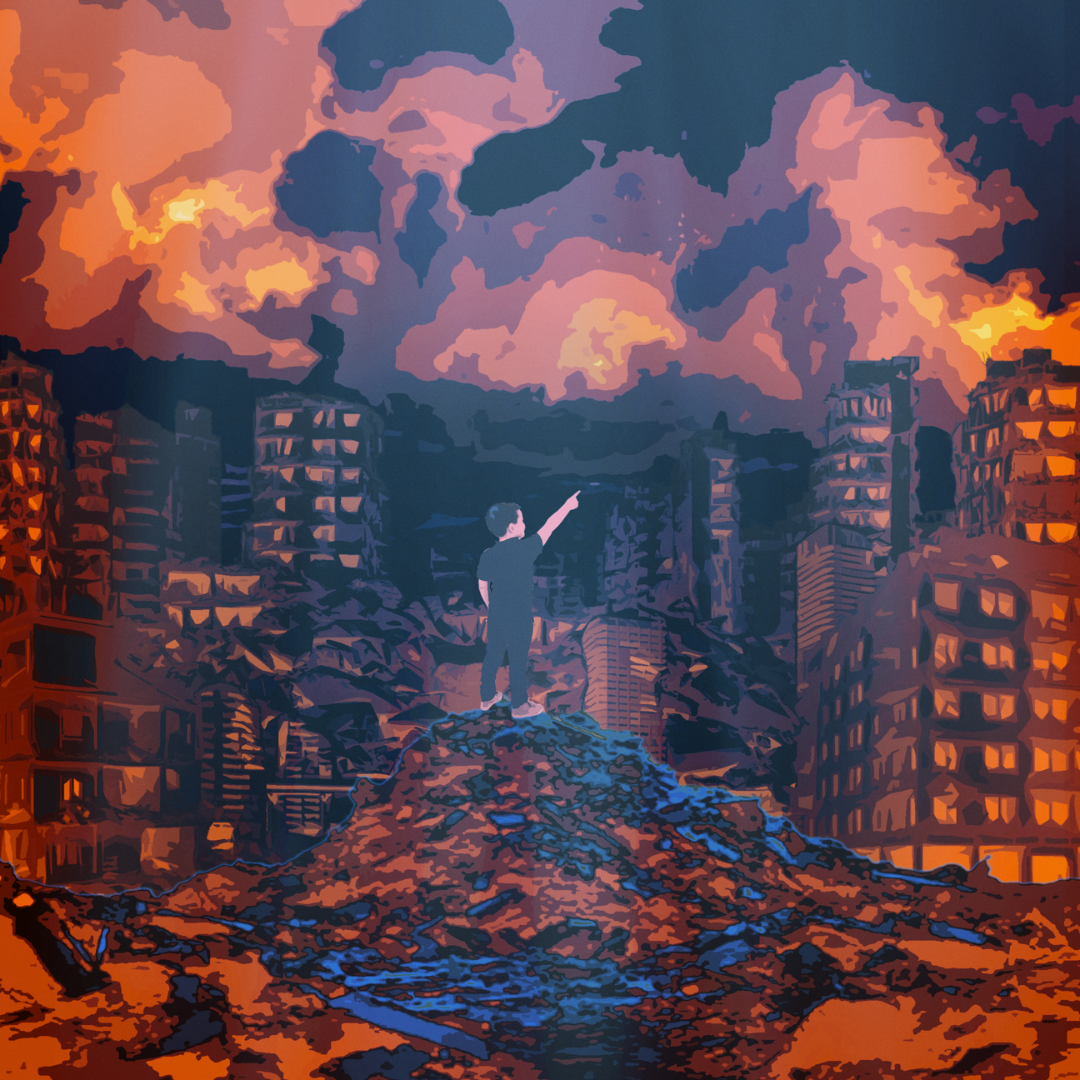
Have you ever tried waking up in the same nightmare, again and again?
In Gaza, every morning begins with remembering. Every sunrise drags with it the weight of the lost homes, lives, and dreams. They wake not to birds or prayer, but to the kind of silence that comes after the sirens — the silence that smells of dust and diesel, and the sound of people that hums with grief. Floor trembles, not from the missiles anymore, but from the ghosts that still move beneath the rubble.
Two years have passed since the bombs and missiles started falling even more. On October 7, 2023, Hamas-led gunmen attacked southern Israel, killing about 1,200 people and taking 251 hostages.
In response, Israel launched what became one of the most devastating military campaigns in recent history — an operation that blurred the line between defense and erasure. According to Gaza’s health ministry, at least 68,000 Palestinians have been killed since then. Most of the 1.9 million has also been displaced, which came with a widespread destruction and severe shortages of food, fuel, medicine and shelter.
Israel and Hamas have agreed to a ceasefire starting on January 19, 2025 to halt the devastating 15-month war in Gaza, Qatar’s Prime Minister says. But even in stillness, the violations continued,
Just this October 2025, U.S. Vice President JD Vance remarked during a visit to Israel that the implementation of the Gaza ceasefire was “going better than expected.” But for those still trapped beneath collapsed buildings and collapsed promises, such optimism felt foreign. The world might have called it peace, but Gazans knew better.
And yet, even if this apocalypse was expected to “end,” people began to ask the questions they had forced themselves to ignore. They already knew the answers – who was gone, who would not be coming back – but saying the words out loud made it real. The silence that followed was heavier than any explosion they had survived.
The Sea as the Border
In 2025, a new wave of resistance sailed into Gaza’s story. On August 31, 2025, the Global Sumud Flotilla — a coalition of more than 50 ships carrying food, medicine, and baby formula — departed from Barcelona, its decks crowded with activists, doctors, and seafarers from 44 countries.
By September 4, a second wave of vessels was scheduled to depart from Tunisia, joined by ships from Italy, Greece, and other ports across the Mediterranean. For weeks, the flotilla drew international attention, with United Nations experts warning Israel to cease all threats against the convoy and to ensure it proceeds unhindered in its mission to deliver humanitarian aid.
In an article on October 2, 2025, one of the flotilla’s lead vessels, Alma, reported a confrontation with an Israeli warship. Activists said the warship “aggressively circled” the civilian boat, forcing evasive maneuvers and cutting off communications.
Minutes later, the same military vessel performed what the flotilla described as “harassing maneuvers” on another ship. The Israeli government maintained its position: the flotilla would not be allowed to reach Gaza.
Seventeen years of blockade — restricting food, fuel, medical supplies, and shelter — have rendered life unlivable, disproportionately harming women and children. The experts described these measures as collective punishment, explicitly forbidden by humanitarian law.
Gaza has long lived in this half-sleep between drowning and waking, between memory and warning. Each boat carried not only food and medicine, but the belief that dignity can still move across waters that have long been weaponized against it.
Yet dreams in Gaza are easily intercepted. They can be detained, disassembled, or drowned in the name of security.
Where the Dreamers Don’t Wake
Two years after the skies of Gaza caught more intense fire, the land still counts its dead. At least 67,000 Palestinians have been killed since 2023, according to the Ministry of Health. That is one in every thirty-three people — or about 3 percent of Gaza’s pre-war population — erased. Thousands more remain trapped beneath collapsed homes, uncounted and unnamed, waiting to be unearthed not as survivors but as memory.
Among the dead are at least 20,000 children. For every hour that passed in the last two years, a child’s heartbeat was silenced. The Ministry admits the official count is incomplete — for how do you count those buried beneath concrete, or those lost entirely, whose bodies and names dissolved into dust?
The war did not end when the bombs stopped falling; it only changed its shape. More than 169,000 people have been injured, many left with wounds that cannot heal in a place without medicine or electricity.
UNICEF estimates that 3,000 to 4,000 children have lost one or more limbs — children who now dream of running, though their legs were left behind in the ruins. Hospitals, what few remain, have turned into graveyards of hope. Doctors operate without anaesthesia; nurses sterilize wounds with only salt water. The sound of every surgery is the same as the sound of mourning and dying.
Even hunger has become an executioner. Over 2,600 Palestinians have been killed and 19,000 wounded while trying to collect food from GHF aid sites, according to Gaza’s Ministry of Health. One Israeli soldier called these areas “a killing field.” Haaretz reported that troops were ordered to fire on anyone gathered near the aid trucks.
Moreover, more than 10,800 Palestinians remain imprisoned in Israel, including 450 children and 87 women. Many were taken in night raids or mass arrests, pulled from their homes like weeds. At least 3,629 are held under administrative detention — imprisoned indefinitely without charge or trial, accused in silence, condemned without evidence. For them, time is another form of torture.
Nearly 300 journalists and media workers have been killed since October 7, 2023 — including 10 from Al Jazeera, according to the Shireen Abu Akleh Observatory. The people who tried to show the world the truth now lie beneath the same rubble they documented.
But numbers, no matter how staggering, cannot translate grief.
Statistics do not breathe, weep, or dream. They cannot tell you what it means for a father to find his son by the color of his shirt, or for a mother to recognize her child by their hair. They cannot describe the unbearable quiet that lingers after the explosion — the kind that settles in your bones and never leaves.
This is not just war; it is the slow erasure of a people’s pulse. Gaza does not sleep — it drifts in and out of consciousness, trapped between nightmare and memory.
Architecture of a Nightmare
When the ceasefire took effect, the people of Gaza began their slow procession. They moved like a tide of return, not toward safety, but toward the skeletons of what used to be home. Entire neighborhoods had vanished. The walls where families once marked the height of growing children now stood as gray powder.
What awaited them was not homecoming, but afterlife.
“Since this morning, we have seen families walking towards Gaza City. We saw children, women, elderly, cars, vans, donkey carts loaded with furniture. Families removed their makeshift tents to take and reset them over the ruins of their destroyed homes in Gaza City.” a report by Tareq Abu Azzoum said.
In this year alone, according to the UN Office for the Coordination of Humanitarian Affairs, by August, 92 percent of all residential buildings and 88 percent of commercial facilities in Gaza had been damaged or destroyed. Satellite analysis by UNOSAT found that as of July 8, nearly 78 percent of all structures across the enclave were gone — a city reduced to dust maps and digital measurements.
“I won’t hide from you that I suffered a stroke and lost consciousness from the shock. To see four of your houses turned into piles of rubble is not easy to accept,” said a 60-year-old contractor in the construction industry.
With 62 percent of residents lacking legal documents to prove ownership, rebuilding may turn into another war — one fought with papers and policies instead of missiles. Many Palestinians now face permanent displacement, unable to reclaim their homes even if reconstruction begins.
The siege’s damage runs through the very veins of the city: 89 percent of Gaza’s water and sanitation network has been destroyed, leaving 96 percent of households water insecure. Sewage seeps where wells once flowed.
Education, too, has fallen to rubble. Over 2,300 educational facilities, including 63 university buildings, have been obliterated. Up to 92% of schools need complete reconstruction. At least 780 educators are gone. And more than 658,000 school-aged children and 87,000 university students have been left without classrooms.
The very places meant to shelter learning now serve as shelters for the displaced. In Gaza, the lesson is survival itself.
“I had hoped to return and find my home standing, but what I found was quite the opposite. I couldn’t even recognise the area. Everything was levelled to the ground,” Suhair al-Absi said.
To rebuild here is to wrestle with ghosts. Every tent staked over shattered cement is both defiance and despair — a declaration that even if the land forgets its own shape, its people will not.
“I will live in the same destroyed area where I grew up. A person can only feel safe and at peace in the place they belong to,” Absi added.
Perhaps the cruelest thing about this nightmare is that it asks its survivors to dream again, to imagine life among the rubble while the world debates whether they are worthy of repair.
Even Hunger Dreams Here
In Gaza, hunger has become its own kind of warfare — silent, methodical, and unrelenting. Israel’s military restrictions have orchestrated a famine, turning the act of eating into an act of survival.
For months, food aid convoys have been trapped behind borders, while the few trucks that are allowed through arrived late, inspected to exhaustion, and often intercepted before they can reach the people who need them most.
As of October 12, at least 463 people — 157 of them are children — have died from starvation under the blockade. Nearly one in every four children is suffering from severe acute malnutrition.
On August 22, the United Nations-backed Integrated Food Security Phase Classification (IPC) declared what Palestinians have long known in their bones: famine has come to Gaza.
It is the first officially recognized famine in the Middle East, one entirely man-made.
The IPC warned that Gaza Governorate, already engulfed in famine, could soon be joined by Deir el-Balah and Khan Younis, where nearly a third of the population — 641,000 people — are facing catastrophic hunger.
The famine has become the face of a siege that does not rely on bullets alone. It seeps through empty markets, through the stench of spoiled grain, through the thinness of children who have forgotten what full feels like.
One mother recounted that she tried to keep her son away from seeing the cheese in the market. Instead, in hopes to satisfy her child’s hunger, she gave him one shekel to buy a falafel sandwich.
“I don’t want the falafel that hurts my stomach, the tasty cheese is what I want,” he replied.
In that moment, her heartbreak was primal. It was hunger made visible.
Under the ceasefire, Israel was meant to allow 600 humanitarian aid trucks into Gaza each day. Instead, the number was halved — and even those that passed inspection faced hours, sometimes days, of delay. Satellite images from mid-October showed convoys of trucks idling on the Egyptian side of Rafah, the sun beating down on supplies that could have saved lives.
The United Nations Relief and Works Agency (UNRWA), which holds enough food to feed Gaza for three months — 1.1 million food parcels, 2.1 million sacks of flour — remains blocked at the border. Israel’s restrictions keep warehouses full and stomachs empty.
Hunger, here, is not a consequence of war. It is the war.
And perhaps the most haunting truth of all is this: Gaza is a land where even famine must queue for permission to enter.
The Morning After the End
And so, Gaza wakes again.
Every dawn feels like an aftershock — a repetition of the same dream where peace smells of smoke and survival tastes like dust. They rise to sweep the same floors that no longer exist, to boil water that no longer runs, to count the living before they count the dead.
They said the war had ended. They said peace had finally arrived. But what kind of peace leaves its people starving? What kind of peace rebuilds no homes, fills no stomachs, buries no bodies? What kind of peace demands that you survive beneath the rubble and call it mercy?
Two years after, Gaza has become a geography of memory. Houses have turned to dust, food has turned to longing, and every silence is a kind of scream. Yet somehow, amid the ruins, people still wake. They still open their eyes to the same nightmare — and choose, again and again, to survive it.
The world calls this “the aftermath.” But there is no “after” when the wound keeps reopening. The famine continues, the walls remain, the checkpoints multiply. Aid convoys wait at borders while children die in line for bread.
We can no longer speak of Gaza in just statistics and political statements. These are not numbers; they are names carved into absence. They are lives that wet taken away. And every one of them demands to be remembered not as tragedy, but as a proof that humanity failed where it should have listened.
The world cannot continue to look away while children starve before our screens, while mothers cradle ghosts instead of sons, while aid waits behind fences for a permission that never comes. We cannot speak of humanity and then stay silent when humanity itself is being starved, bombed, and buried.
The rubble of Gaza is not just the ruins of a city — it is a mirror held up to the world. It reflects not only the violence of bombs, but also the cruelty of those who chose to look away.
Peace is not the silence that follows destruction. It is the sound of rebuilding, the sound of a child’s laughter returning to the streets, the sound of people breathing again with the hum of life. And until that sound returns to Gaza, none of us can call ourselves at peace.
Because indifference is not neutrality, it is complicity. And silence, like hunger, kills.


Leave a Reply