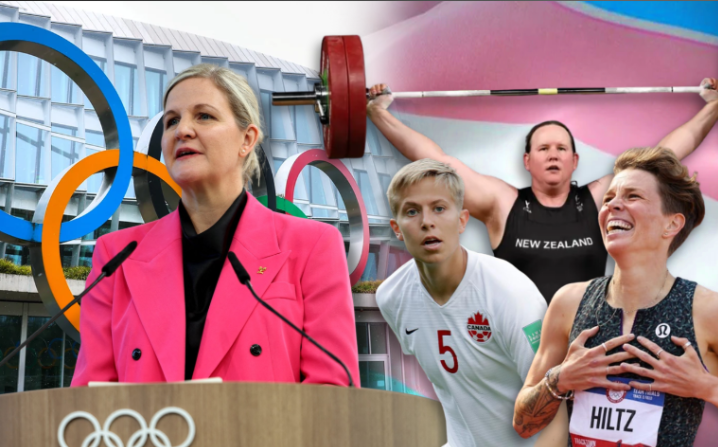
Ramping up for the 2028 Olympic season, the International Olympic Committee (IOC) announced a new policy limiting eligibility in women’s events to biological females, thereby barring transgender women athletes from competing in the 2028 Los Angeles Olympic Games onward, March 26.
Under the policy, the rule applies across all disciplines in the IOC sports programme, including individual and team events, with participation determined through a one-time swab-based screening for the SRY gene, a marker linked to male sex development.
Athletes with certain differences of sex development (DSDs), including Complete Androgen Insensitivity Syndrome (CAIS), may still qualify, provided their condition does not confer a performance advantage linked to testosterone.
According to the IOC, athletes who test positive for the SRY gene, including transgender XY or androgen-sensitive XY-DSD athletes, are ineligible for women’s events but may continue to compete in male categories, open categories, or sports that do not classify participants by sex.
Those who screen negative for the SRY gene automatically meet the IOC’s eligibility requirements to compete in the female category at Olympic events.
IOC President Kirsty Coventry, elected last year as the first woman to lead the organization, said the change was implemented with gender equality and access to elite sport in mind.
“The policy that we have announced is based on science and has been led by medical experts. At the Olympic Games, even the smallest margins can be the difference between victory and defeat,” Coventry explained.
“So, it is absolutely clear that it would not be fair for biological males to compete in the female category. In addition, in some sports it would simply not be safe,” she continued.
Coventry emphasized that athletes should have access to clear guidance on the process, including counseling and expert medical advice.
Despite the policy’s stated intent, criticism poured in from both the medical community and athletes, who questioned its scientific basis and potential impact.
Among the athletes who have previously participated in elite sports, American transgender middle-distance runner Nikki Hiltz has also spoken publicly on the new policy.
“Attacks on trans people have consistently led to more policing and regulation of all women’s bodies. Everyone is hurt by transphobia,” Hiltz said in an Instagram story.
Dr. Ada Cheung, a professor of endocrinology at the University of Melbourne warned that IOC’s move could undermine evidence-based policymaking and athlete well-being.
“The IOC’s move to mandate sex testing across the female category risks undermining both evidence-based policy and athlete wellbeing, while diverting attention from the real priorities in women’s sport,” said Cheung.
Further criticism came from Nikki Dryden, a former Olympic swimmer and human rights lawyer, questioning the policy’s implications.
“If these rules are adopted, it could mean that when you sign your daughter up to play sport, she may be subjected to sex testing just to participate,” she said.
Dryden added that the policy could create a culture where athletes’ bodies are even more scrutinized.
This concern comes amid a history of transgender athletes and those with DSD competing at the elite level since the early 2010s and 2020s. One of the most recent high profile DSD cases is Imane Khelif, who competed in the 2024 Paris Olympics.
Khelif is biologically female and competes under the female boxing category despite the presence of male chromosomes and hormones in her body.
Meanwhile, Angelite volleyball player and transwoman Arkie Montoya Manangan noted that the issue has already drawn attention locally, particularly within collegiate leagues.
“For instance, there have been online discussions in recent years regarding the participation of Trisha Tubu,” she explained.
“These discussions raised questions about gender identity and eligibility in women’s volleyball, sparking broader debates about fairness and inclusion in sports,” Manangan added.
Manangan’s volleyball teammate, transwoman Carly Marzan, said she believes “it’s fair to publicly implement the new policy.”
“As a transwoman playing in the men’s category in my whole career up to this day, I say that I can dominate in the men’s division,” Marzan noted.
Similarly, Samahang Weightlifting ng Pilipinas President Monico Puentevella called for a bill to ban transgender athletes from competing in Philippine sports, saying it would be “fair” for individuals to compete in the category corresponding to their birth gender, a statement he made in November 2023.