National Grid Corporation of the Philippines (NGCP) once again placed the Luzon grid under yellow and red alerts on May 15, prompting electric cooperatives and distribution utilities across Pampanga to implement Manual Load Dropping (MLD) amid a continuing power supply deficiency that has persisted since May 13.
The renewed alerts came only hours after earlier grid warnings were lifted, raising fresh concerns over the stability of the power supply and the possibility of rotational outages in affected areas.
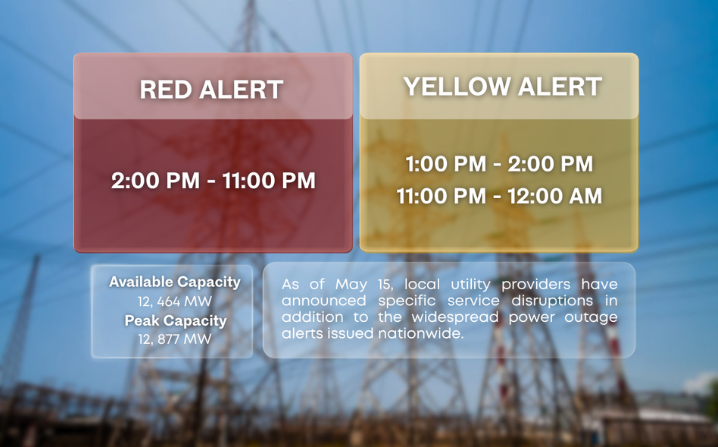
According to NGCP, yellow alerts were issued from 1:00 p.m. to 2:00 p.m., following an extended red alert period from 2:00 p.m. to 11:00 p.m., and another yellow from 11:00 p.m. to 12:00 a.m.
These alerts were raised after 17 power plants in Luzon experienced forced outages since the beginning of May.
Despite the official statements, online community threads were flooded with mounting demands from consumers, citing “lack of consistency in interruption schedules.”
Residents urge distribution utilities to provide a more accurate timeframe, as many reported outages occurring outside of unannounced windows.
A netizen on Facebook called on authorities to clearly identify the areas affected by scheduled power interruptions, as support grows for a petition seeking a more humane blackout schedule amid intense heat conditions.
“Puwede po bang ilatag ang mga areas na affected para hindi damay sa oras ng trabaho?” a commenter asked, further stressing the need to avoid disruptions during working hours and peak daytime heat.
NGCP clarified that while rotational disruptions are scheduled, these may be deferred if system frequency stabilizes. Alerts remain active as the Department of Energy (DOE) and NGCP continue to monitor the restoration of affected power plants.
As of May 15, local utility providers have announced specific service disruptions in addition to the widespread power outage alerts issued nationwide.
Angeles Electric Corporation (AEC) conducted a line rehabilitation from 5:00 a.m.to 10:00 a.m., affecting portions of Sapangbato, Sapang Kalawang, and Sition Target.
Clark Electric Distribution Corporation (CEDC) similarly warned of potential outages within the Clark Freeport Zone, noting that the stability of the local network is tied to the overall health of the Luzon Grid.
Meanwhile, San Fernando Electric Light and Power Company (SFELAPCO) notified consumers of a rotational power interruption scheduled for a five-hour outage from 8:30 a.m. to 1:30 p.m., targeting a portion of San Jose.
In a Facebook post, SFELAPCO explained that a Yellow Alert is declared when the country’s power reserve becomes low, while a Red Alert is raised when electricity supply falls below the actual demand of consumers.
The electric cooperative attributed the situation to the intense heat index, which has led to the simultaneous use of cooling appliances such as air conditioners and electric fans, while several power plants are either temporarily non-operational or generating insufficient electricity.
Furthermore, SFELAPCO clarified that the rotational brownouts are not implemented by them, as such measures are determined and enforced by the grid operator, NGCP, whenever deemed necessary.
“Hindi dapat magkaroon ng takot kung magkaroon man ng rotational brownout o Manual Load Dropping (MLD). Ang pagbabawas na ito sa paggamit ng kuryente ay isang planadong hakbang upang maiwasan ang mas malalang problema o total blackout sa buong bansa,” SFELAPCO stated in its advisory.
Power Interruption schedules also extended to areas under Pampanga II Electric Cooperative (PELCO II), affecting multiple municipalities such as Guagua, Lubao, Porac, Minalin, and Santo Tomas.
These alerts further expanded as Tarlac II Electric Cooperative, Inc. (TARELCO II) issued an advisory for a power cut from 5:00 p.m. to 8:00 p.m., which affects all barangays of Capas and Bamban, including some barangays of Mabalacat, Pampanga.
TARELCO II noted that these distributions are planned, but the implementation remains dependent on real-time system conditions.
The DOE said it is actively coordinating with NGCP, Independent Electricity Market Operator of the Philippines (IEMOP), Energy Regulatory Commission (ERC), generation companies, and other industry stakeholders to speed up the safe restoration of affected facilities and implement measures to stabilize the power grid and protect consumers.