I’ve rewritten this letter more times than I’d like to admit.
Every version sounded like advice, and I don’t think that’s what you needed. Advice is what people give when they already know how the story ends. You don’t. You’re still in the middle of yours, still innocent about the world around you.
I keep wondering where to begin.
Let me start with the day the neighborhood boys laughed because your wrists moved too much when you talked, or your titas asking if there was already a pretty girl in your class — the whole table waiting for an answer that would make them laugh. I could begin with the first time someone called you bakla as though they were spitting out something bitter.
But those aren’t the memories that visit me the most. I always return to the Barbie.
She wasn’t even yours. She belonged to your cousin, abandoned beneath her bed with a missing shoe and hair that had become one impossible knot. The other boys hardly noticed her. They were outside racing toy cars over cracked cement, making machine-gun noises with plastic soldiers whose arms had long since fallen off.
You picked her up because she looked lonely. At least, that’s what I tell myself now.
Back then, you wouldn’t have known how to explain it. You only knew that you wanted to fix her hair. So you sat cross-legged on the floor, using your fingers to untangle the strands one by one, patient in the way only children can be. You smiled when her hair finally lay flat. It felt like an accomplishment.
Then your cousin’s older brother appeared. He laughed, called for the others, and before long, the room was full of voices asking why you were playing with dolls instead of joining the boys outside.
Someone took the Barbie from your hands and tossed you a toy car. The conversation moved on.
Children are remarkably good at pretending nothing happened. But I know you carried that afternoon longer than anyone realized. Because, for the first time, you understood that there were things you could love only when no one was looking; take, for example, years after that, Inang’s lipstick.
One afternoon, while she was outside taking down the laundry before the rain, you opened her bag. You looked toward the door once. Then twice. Only when you were certain no one was coming did you twist it open.
You expected it to smell sweet. Instead, it smelled faintly of wax and roses. The first swipe was uneven. You laughed at yourself. The second looked better. You leaned closer to the mirror, tilting your face toward the light spilling through the window.
I still remember that smile. It was one of the few times you looked at yourself without asking whether you were too much. You weren’t forced to become someone else yet. You were simply curious about yourself.
I wish curiosity had been allowed to remain innocent.
Instead, you heard the gate creak open — Inang was home.
You scrubbed your lips with the back of your hand until the color disappeared. When that wasn’t enough, you rubbed harder with the edge of your shirt. By the time she stepped inside, there was nothing left except the sting.
Years later, I realized something that still breaks my heart. No one had called you disgusting. No one had even seen you. And yet you had already learned to erase yourself.
Then there were the sampaguitas. They grew over Aling Baby’s fence, just low enough that you could reach them if you stood on the hollow block near the drainage canal. The girls in the neighborhood liked tucking them behind their ears while playing bahay-bahayan.
You thought they looked like tiny moons against dark hair. One afternoon, they tucked one behind your ear too.
But then an older boy walked past. He laughed. The girls grew quiet. You reached for the flower in your ear so quickly that it slipped from your fingers and landed in the canal. We both watched it drift away.
Funny, isn’t it? I can’t remember what that boy said. I don’t remember what shirt he was wearing or where he went afterward. But I remember the flower. I remember thinking that it floated so easily, as though it belonged to the water more than it had ever belonged to you.
Sometimes I wonder how many parts of ourselves we have dropped simply because someone laughed.
Perhaps that’s when your pagdadalaga truly began — when you realized the world had already decided what difference deserved.
I wish I could tell you that things became easier after that.
They didn’t.
Growing up has a way of teaching children which parts of themselves are welcome in the light and which ones should remain hidden. You learned quickly. Your laughter became quieter. Your hands stayed closer to your sides when you spoke. Before entering a room, you began wondering whether there was a right way to stand, a right way to smile, a right way to exist.
You asked yourself: what is happening to me? Why do I feel this way? Will I always be different? Is there someone I can ask?
Children are born believing that adults know everything. It takes a long time to realize that adults are often just as frightened of certain conversations as children are. They knew how to tell you to study hard, to respect your elders, to pray before sleeping, to avoid strangers.
But when it came to your body, your heart, the confusing ache of wanting to be seen and fearing what would happen if you were, everyone grew quiet.
That silence followed you everywhere.
It sat beside you in Religion class whenever love was spoken about, as though it belonged only to certain people.
It lingered in Science class, where you learned the parts of a tree in remarkable detail but left school knowing almost nothing about your own body.
It waited at the dinner table, where conversations ended the moment they became uncomfortable.
It knelt beside you every Sunday Mass, where you memorized prayers before anyone taught you that caring for yourself could also be a sacred act.
So you learned the way many of us did.
From whispers in school hallways, friends who were only repeating what they had heard from someone else, late nights scrolling through glowing screens, trying to separate truth from rumor, tenderness from fantasy, love from loneliness.
No child should have to become their own teacher.
Years from now, you’ll meet people whose stories begin exactly where ours did — with questions no one answered.
One of them will tell you that he waited outside an HIV clinic for almost an hour before finding the courage to walk in, afraid someone from his neighborhood might see him. In the end, he said the waiting was harder than the test itself.
Another will tell you that when the counselor gently explained that his result was reactive, he barely heard the rest of the conversation. His first thought wasn’t about medicine. It wasn’t even about dying.
He thought about his mother. He wondered how he would explain something that no one had ever explained to him. I think about that often.
How many people carry guilt for things they were never given the chance to understand? How many spend months, even years, avoiding clinics because shame has convinced them that being seen is more frightening than being sick? How many believe that silence can protect them because silence was all they inherited?
I don’t want you to inherit that.
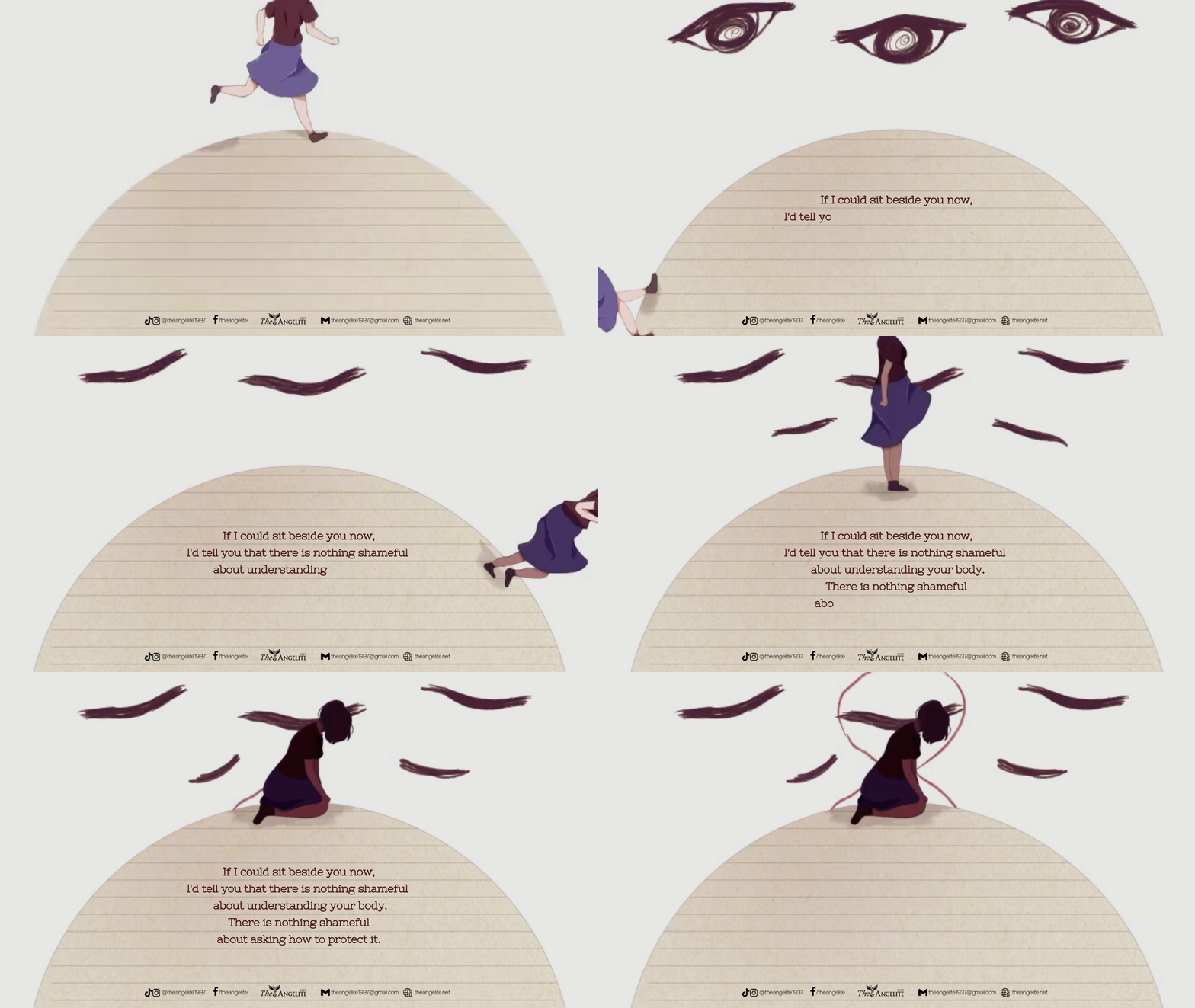
If I could sit beside you now, I’d tell you that there is nothing shameful about understanding your body. There is nothing shameful about asking how to protect it.
Carrying a condom will never make you irresponsible. Getting tested will never make you impure. Walking into a clinic is not an admission of guilt; it is one of the quietest ways of saying, My life is worth taking care of.
And if, one day, someone you love tells you they are living with HIV, don’t let your first response be silence. Sit beside them. Ask if they’ve eaten. Offer to go with them to their next appointment if they’re afraid to go alone.
Learn the names of their medicines the way you would remember a friend’s favorite song or the birthday of someone you love. Because people are never reduced to the hardest thing that has happened to them.
So if another little boy ever stands in front of you with a flower tucked behind his ear, or a smudge of lipstick he forgot to wipe away completely, or questions he cannot bring himself to say out loud, I hope you remember this letter.
Don’t laugh. Don’t look away. Don’t tell him he’s too young. Pull up another chair. Let him ask.
Then answer with the kindness we spent so many years searching for. Because your pagdadalaga was never something that needed correcting.
It only needed someone brave enough to protect it.
With love,
Your older self