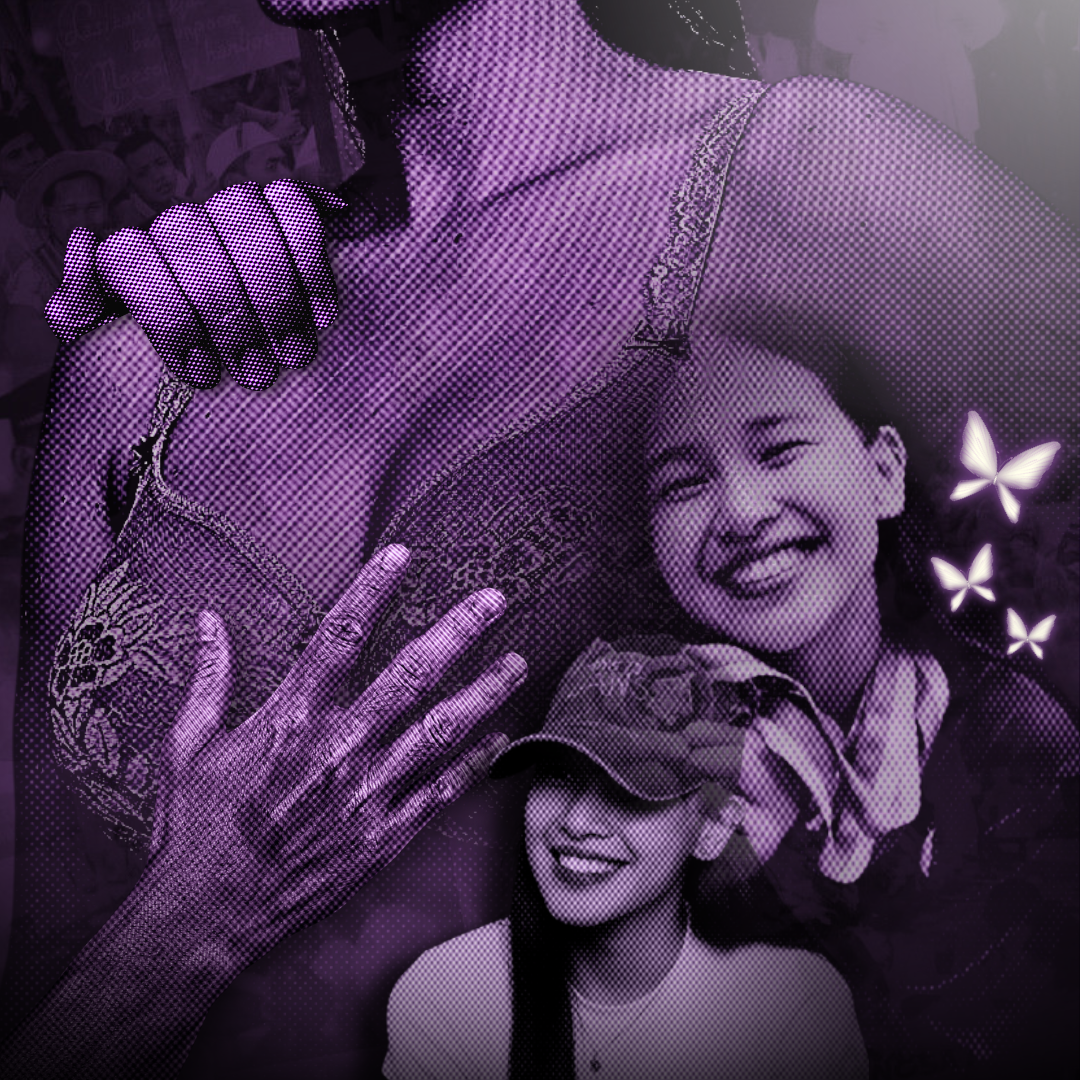
She did not ask to become a measuring stick of womanhood. But that is what the internet had made her — a benchmark against which every other woman’s worth is now weighed.
Rising to six million followers across Facebook and TikTok, content creator Lans built her account on educational, wholesome videos, sharing her genuine and pleasant aura to the internet — unintentionally fitting into the standards shaped by viewers that take pleasure in policing “imperfect women.”
It should have been simple: a young woman sharing her passion for veterinary medicine and public welfare. Instead, it became a referendum on what a “good woman” is supposed to look like.
Amidst the craze, TikTok has since split into varying perspectives. Some users credit Lans with ending the “thirst trap” era, praising her for setting a new, wholesome standard for women online. Others point to a toxicity, largely from male supporters, that uses Lans to condemn other women for failing to be her.
Both reactions come from the same root. Traditional roles and the cultural perception of modesty has long drawn the projection of a demure and nurturing aura towards women — shaping the people’s perception of an “ideal woman” for generations.
And Lans, apparently, had become the latest woman measured against it. Which raises the question: what does it actually take to be a “good woman” in the Philippines — and who gets to decide?
Illusion of ideal
Respect, for Filipino women, has rarely been unconditional. Over the years, it has been treated as a prize, handed out for compliance and revoked at the first sign of defiance.
Filipino content creator Louise Anne Nagal, or better known as Lans, was not spared from this trial. With a persona that seems to fit neatly into the public’s shortcuts for what a “good woman” should be, she was immediately treated as a symbol — policing and disciplining other women who do not fall under their preference.
A TikTok post by user izaaa.yk called this out, stating that some male fans are praising Lans for her educational content while using her as a weapon against creators with “thirst trap” content. The comparison said less about Lans than about the men making it.
This shows how social media distorts reality. A genuine personality enters the scene, and within days, they are immediately placed on a pedestal that assesses every characteristic they possess.
To misogynistic eyes, conformity equates to respectability, and those who deviate from modesty are crucified.
Lans’ actual content rarely resembles the conversation around it. She shares educational content, often showcasing her raw, authentic passion for public welfare and veterinary medicine. But regardless of the time and care put into it, comments about her appearance still outnumber those that praise her work.
She has said as much herself, expressing disappointment on Facebook that some viewers tune out everything she says and simply watch her for how she looks.
This is where the real problem lies, a pattern so difficult to miss once it is named: women’s bodies get judged faster before their purpose is even seen.
Their voices reach an audience, but rarely an audience that is actually listening. Their appearance, meanwhile, stays permanently on trial.
The price of individuality
In this country, respect is still a currency, and women are routinely asked to pay for it in pieces of who they are.
But when conformity becomes the exchange rate, individuality is therefore compromised. The more of her that a woman trades away, the more “respectable” she is allowed to become in the eyes of whoever is deciding the terms.
Policing women to become different versions of themselves strips them of their right to self-expression. When a woman reshapes herself into the archetype the crowd finds palatable, the respect she eventually receives is merely a reward for patriarchal obedience.
Quezon City 4th District Rep. Jesus “Bong” Suntay’s remarks about Anne Curtis made that transaction visible.
Using the Filipina actress as a subject in an intimate scenario without her consent or context shows how objectification is rarely self-inflicted. It tends to come from a mind already conditioned to treat a woman’s existence as material for pleasure and consumption.
Lans’ words echo this, stating that a woman’s presence online was never up for debate in the first place.
“A woman can be confident, expressive, feminine, strong, matalino, creative, o simply comfortable being herself by posting photos, dressing a certain way, or expressing themselves online,” she said. “The way we dress is never an invitation for disrespect.”
Jinelle Flores, a first-year BS Medical Technology student, affirmed the statement, stating that “A girl doesn’t dress for a man’s approval; she dresses for her confidence, comfort, and happiness.”
One netizen also replied to Lans’s public statement, stating, “Thank you for pointing out what should’ve been obvious to everyone.”
Obvious yet still necessary to say out loud in the modern age of 2026 from someone with a following large enough to make them listen.
A patriarchal blueprint
Lans has been careful not to let her platform be misused. She has said, more than once, that it makes no sense to hold her up as a standard for decency and respectability because she herself had fallen victim to misogyny.
“Maging ako po mismo ay hindi rin nakaligtas sa pambabastos, tapos sasabihin ng iba yan sa ibang babae? Wala rin pong sense,” she said on a Facebook post, addressing the comments telling other women to be like her.
In 2021, sociologist Beatriz A. Torre found that sexism persists in the daily lives of Filipino women regardless of sexual orientation, where 98% of the participants reported experiencing some form of sexist remark or action within just two weeks — most commonly, comments dictating characteristics or behaviors women ‘should’ exhibit.
That number holds regardless of a woman’s fame, her values, or her intentions. It reaches women long before they have a platform to defend themselves on.
Even young girls are trapped under the microscope of misogyny. They learn this early, often on the street. A 2026 study by Alampas et al. found that gender-based street harassment among young girls occurs at a moderate but persistent level, with catcalling and wolf-whistling among the most common “unwanted interactions” reported.
In an interview, a BS Medical Technology student who requested anonymity, reported getting catcalled by tricycle drivers for wearing a skirt on a hot day.
Another BS Nursing student who requested anonymity was catcalled in her white uniform — a wardrobe that was meant to show professionalism, not an outfit that draws attention.
Neither had dressed for anyone’s approval. Neither had asked to be looked at.
The fault was never in what they were wearing nor in how they carried themselves. It sat instead in the mind of whoever decided that a woman’s body becomes public property the moment it enters his line of sight.
These occurrences prove how young women continue to face a harsh, sexist reality, consistently treated as objects that appeal to the standards set by society.
Respect, it seems, is only for those who fit under the stereotype of female modesty. While those who defy modesty are punished for their expression of individuality.
To these eyes, every catcall and dehumanizing gaze is a remark that has been “called for” by an unsuspecting girl who simply wanted to express herself.
And yet the burden of proof still finds its way back to the victims, crucified for the actions they never asked for.
The Domestic Violence Services Network, Inc. (DVSN) defines victim blaming as the act of placing responsibility for abuse on the survivor rather than the abuser, rooted in the belief that she must have done something to provoke it.
Neither student had dressed or acted any differently than usual that day, and yet the harassment had happened.
Lans said it herself, being held up as proof that respectability protects you does not make it true. She was not spared. These girls were not spared either.
This is the blueprint at work: girls memorize a hundred rules about hemlines and eye contact and walking speed, and the danger finds them anyway, because the rules were never really built to protect them at all.
Who the stereotype hurt
Underneath all the noise, Lans is just a student trying to share what she cares about. But social media had other plans for her, flattening that passion into merely eye candy — a face to rate rather than a voice to hear.
Other students who watched the controversy unfold recognized the shape of it immediately because they have lived inside that same shape for most of their lives.
Aika Jhane Panaguiton, a BS Psychology student, views the online remarks as a reflection of our society’s discomfort towards women’s deviance from traditional roles.
She said that women are often forced to compromise their individuality for conformity — and that society keeps limiting them by normalizing these stereotypes.
“Lans is being idealized and she’s boxed into a role that she never necessarily asked to represent,” she voiced. “She stopped being viewed as her, and became a symbol instead.”
John Lawrence Capulong, a first-year BA Communication student, suggests that sexism will continue to propagate the more it is tolerated by the misogynistic standards set against women.
“Unless we unroot that seed within our society, we can’t stop it from growing into the next sprouts that’ll flourish in the later years,” he said.
To be raised in a country still tangled in macho-feudal values means absorbing these norms as though they were simply part of the air, oppressive from the moment a girl is born into it.
Another first-year BA Communication student, Samantha Rose Naguit, traced the same problem further upstream.
“The environment parents and older men let young men see makes it harder to shake them from patriarchy,” she stated.
Keith Gatbonton, a BS Medical Technology student from Bulacan State University, suggested that victim blaming and misogyny are tied together.
“Women do not act or dress a certain way to attract male gaze. Though there is a tendency that women wear revealing clothes, the sexualization they face is still a problem caused by men’s thinking,” she stated.
She believes that victims are often alienated by the misogynistic beliefs that place the blame on their actions or appearance — when it is men’s objectifying attitudes that are truly at fault.
Meanwhile, Cassandra Denisse Herrera, another BS Medical Technology student, believed that while the stereotypes women face are unlikely to disappear, the fight for respect never ends either.
“These mental shortcuts or people’s assumptions about things won’t totally disappear, but they will lessen as time goes by,” she said. “With a newer generation of Filipinos who are hungry for betterment, some are becoming more vocal in educating people, standing up for their truth, and especially dealing with the political issues we are facing now, which affect our whole lives.”
For her, as long as women keep refusing the misogyny thrown at them, the Philippines may be able to reach a society that empowers female individuality, not crucify it.
Their insights echo the same thought: decades worth of progress have narrowed sexism in our country, but never actually erased it. Filipino society inches a few steps toward equality only to feed on whatever strength women exert trying to reach it.
Eliminating the blueprint
Indeed, no woman should have to think twice before putting on a dress that makes her feel confident, and no woman’s confidence should shatter because it’s been compared beside someone else’s.
Lans understands this better than most, emphasizing that her following means nothing if the people behind those numbers are only there to objectify her rather than actually see who she is.
Support offered as a reward for the gratification of manly desires is not genuine appreciation; it only proves how deeply sexism has learned to disguise itself as praise.
“Women do not have to fit one image to deserve respect,” she said, firm and unwavering.
Only when society stops treating every woman as a case study in search for some elusive “perfect” one can it finally start appreciating what each of them actually brings to it.
Because the epitome of a “good woman” is not defined by the satisfaction of men.
Whether a woman expresses herself boldly or modestly does not define how good of a woman she is. No blueprint dictates how a woman should speak, act, or dress to be truly classified as a “good woman.”
Respect and dignity are not prizes granted to those who fit gender norms and misogynistic standards, and women do not have to apologize for being the way they are.
Because the real problem lies in how women are portrayed, not in the way they show up as authentic versions of themselves.